Azure vs AWS Migration: Which Cloud Platform Actually Fits Your Business?
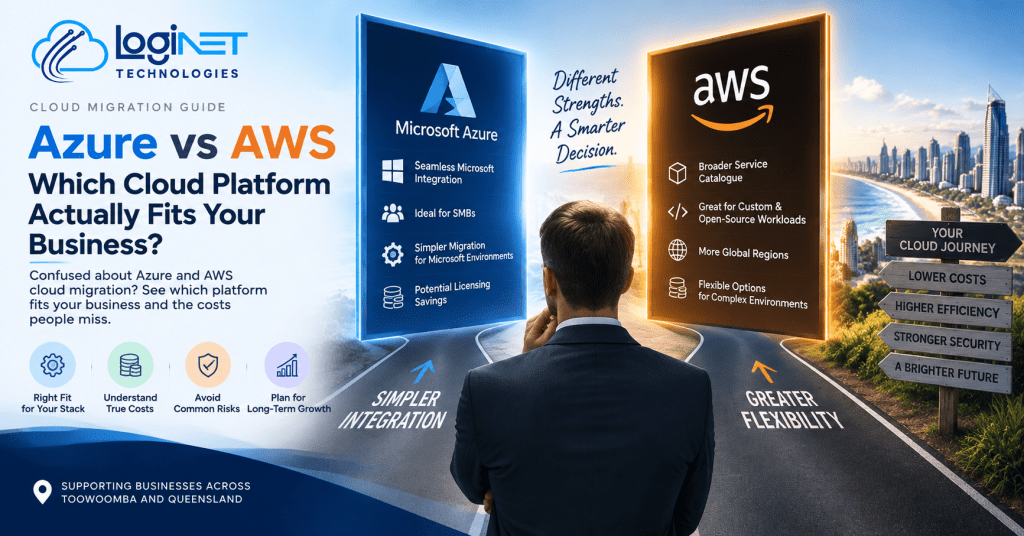
Azure vs AWS Migration: Which Cloud Platform Actually Fits Your Business? Should your business migrate to Azure or AWS? There’s no universal winner here Azure is usually the simpler path if you’re already running Microsoft 365 and Windows Server, while AWS tends to suit businesses with more custom-built or open-source workloads. The right call comes down to your existing stack, what your team already knows how to manage, and the type of applications you’re moving. That’s the short version. Here’s what actually goes into that decision, and what tends to get missed until it’s too late to matter. Azure vs AWS at a Glance Both platforms do the same core job compute, storage, networking, databases, security but they get there differently. Azure was built by Microsoft with tight integration into the tools most Australian businesses already run: Active Directory, Microsoft 365, SharePoint, and Windows Server. If your environment is already Microsoft-centric, a lot of the identity and licensing groundwork is half-done before you start. AWS launched earlier and has grown into the larger, broader service catalogue more regions, more niche services, and a longer track record with businesses running Linux-based, open-source, or custom-engineered environments. It doesn’t assume you’re running Windows anywhere, which is exactly why businesses with a more varied or developer-heavy stack tend to lean toward it. Pricing models look similar on paper pay-as-you-go, reserved instances, and various discount tiers on both sides but the actual bill depends heavily on how your workloads are architected, not just which logo is on the invoice. Where Azure Has the Edge for Australian SMBs For a lot of small and mid-sized Australian businesses, Azure ends up being the more practical starting point, mainly because of where they’re already sitting. If your staff are working in Microsoft 365, your file structure lives in SharePoint or OneDrive, and your identity management runs through Active Directory or Entra ID, Azure lets you extend that environment into the cloud rather than bolt on a second, unrelated system. There’s also a licensing angle worth knowing about: businesses already paying for Microsoft 365 or on-premises Windows Server licences may be able to apply existing licensing toward Azure costs something we look at directly as part of our managed cloud hosting solutions, since the savings depend on your specific agreement. Where AWS Has the Edge AWS tends to win out for businesses running things Azure wasn’t originally built around custom applications, open-source databases, container-heavy environments, or workloads that need a specific regional presence or niche managed service AWS offers and Azure doesn’t. Development teams already comfortable in the AWS ecosystem, or businesses running container-heavy or virtualization services internally, often find migration friction is lower there simply because the tooling already matches what they use day to day. It’s also worth saying plainly: AWS isn’t “the technical one” and Azure isn’t “the simple one” in any absolute sense. Plenty of large, complex enterprise environments run on Azure, and plenty of straightforward small business setups run comfortably on AWS. The fit comes from what you’re running today, not from either platform’s general reputation. Migration Complexity: Lift-and-Shift vs Re-Architecting This is where most migration timelines and budgets go sideways, regardless of which platform you pick and it’s usually tied to how your existing server and storage solutions are set up before the move even starts. A lift-and-shift migration moves your existing applications and servers into the cloud largely as-is fastest to execute, lowest immediate cost, but it usually means you’re not getting the full benefit of cloud-native scaling and cost efficiency. It’s a reasonable first step for businesses that need to get off ageing on-premises hardware quickly. Re-architecting means rebuilding applications to actually take advantage of cloud-native services better long-term performance and cost efficiency, but it takes longer, costs more upfront, and requires a team that understands both the old environment and the new one well enough to not break something important along the way. Most businesses land somewhere in between: lift-and-shift the workloads that don’t need immediate change, and re-architect the ones causing the most pain in their current form. Real Cost Factors People Miss The sticker price on compute and storage is rarely where a cloud migration budget actually blows out. The costs that catch businesses off guard tend to be: Data egress fees: moving data out of the cloud (to another provider, to a backup location, or even back on-premises) often costs more than moving it in, and this is easy to overlook until the first invoice arrives. Licensing complexity: software licensed per-core or per-server on-premises doesn’t always translate cleanly to cloud pricing models, and getting this wrong either overpays or creates a compliance gap. Support tier costs: the free or basic support tier on either platform is rarely enough for a production business environment; a proper support plan is a real, ongoing line item. Idle or oversized resources: cloud environments that aren’t actively managed tend to accumulate resources nobody’s using anymore, quietly adding to the bill month after month. None of these are dealbreakers, but they’re the difference between a migration that stays on budget and one that doesn’t. How to Choose Without Vendor Bias The honest way to make this decision is to start from an inventory of what you’re actually running today operating systems, databases, custom applications, licensing agreements, and where your team’s existing skills sit rather than starting from a platform preference. A proper cloud readiness assessment maps your current environment against both platforms and shows where the friction (and the savings) actually are, instead of guessing based on which platform is better known. Azure and AWS Migration Support in Toowoomba and Beyond Businesses across Toowoomba and Queensland increasingly need Azure and AWS migration support that understands both the platform decision and the practical side of getting there data transfer, staff training, and what “done” actually looks like once the migration is finished. That’s a different conversation from a generic cloud sales pitch, and it’s one worth having with a provider who can speak honestly
Azure vs AWS Migration: Which Cloud Platform Actually Fits Your Business? Read More »