SIEM vs MDR: What’s the Difference and Which Does Your Business Need?
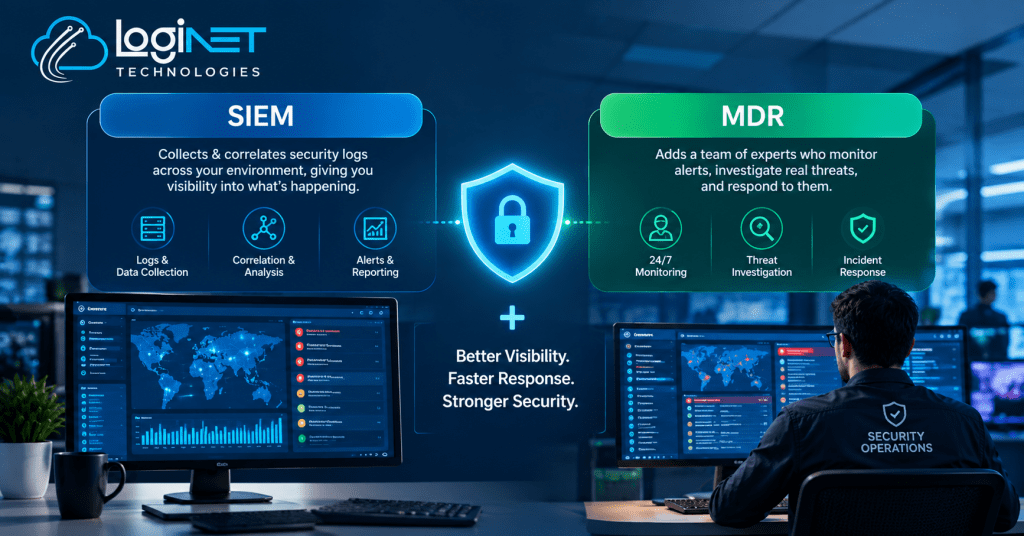
What’s the difference between SIEM and MDR, and which do you actually need? SIEM is the system that collects and correlates security logs across your environment, giving you visibility into what’s happening. MDR adds a team of people actively watching those alerts, working out which ones are real threats, and responding to them. Most small and mid-sized businesses need both working together rather than picking one instead of the other, because each one covers a gap the other leaves open.
That distinction gets blurred a lot in vendor conversations, partly because some providers sell both under similar-sounding packages. Before comparing options for SIEM and threat monitoring, it’s worth being clear on what each piece is actually doing.
What SIEM Actually Does, Without the Jargon
SIEM stands for security information and event management, and at its core it’s a system that pulls together log data from across your network, servers, cloud services, and applications, then looks for patterns that suggest something’s wrong. A login from an unusual location, a spike in failed authentication attempts, a file being accessed at 3am, SIEM is what notices these things happened and puts them in front of someone.
What SIEM doesn’t do on its own is decide what to do about it. It generates alerts and reports, and someone still has to review them, work out which ones matter, and take action. This is where a lot of businesses get caught out buying SIEM as if it were a complete solution, when it’s really the data and visibility layer, not the response layer.
What MDR Adds on Top of That
MDR, managed detection and response, is where SIEM vs MDR stops being two competing products and becomes two parts of the same job. MDR is a service, not just software, a team of analysts actively monitoring the alerts a SIEM (or other detection tools) generates, investigating what’s actually going on, and taking action when something’s genuinely a threat, rather than leaving that work for your internal team to sort through.
The practical difference shows up in what happens after an alert fires. With SIEM alone, an alert sits in a dashboard until someone with the right expertise looks at it. With MDR, that review and initial response happens as part of the service, someone’s actually watching, day and night, and acting on what they see rather than just logging it.
Why One Without the Other Leaves a Gap
Running SIEM without MDR means you’ve built visibility without the capacity to act on it. Alerts pile up, and unless someone internally has both the time and the security expertise to triage them properly, real threats can sit unreviewed among a much larger volume of false positives. This is one of the more common security gaps in small and mid-sized businesses, not a lack of tools, but a lack of people actually watching what the tools are telling them.
Running MDR without any underlying log visibility creates a different problem, the response team has less context to work with, since they’re reacting to whatever detection sources are in place rather than a properly correlated view across your environment. This is also where tools like endpoint detection and response fit in, they feed useful signal into the picture, but they’re not a substitute for the broader log correlation SIEM provides. The two are genuinely complementary rather than overlapping options.
Managed SIEM Queensland: What This Looks Like for a Business Without an In-House SOC
Very few small and mid-sized Queensland businesses have their own security operations centre, and that’s not a gap that needs fixing by building one internally. In practice, this usually means the SIEM and the monitoring/response function are both delivered as a managed service, the technology runs, but it’s watched and acted on by an external team rather than an internal one.
This model works because it separates the two things a business actually needs, visibility and response, from the cost of building both in-house, which for most SMBs would mean hiring specialist staff to sit in a role that’s only fully justified at a much larger scale. [CONFIRM WITH CLIENT: specifics of how Loginet’s own managed SIEM and monitoring service is structured, to state here rather than a general description].
Cost and Complexity: What to Actually Expect
Cost for either SIEM or MDR (or a combined offering) tends to scale with the volume of data being monitored and the number of devices and systems in scope, rather than being a flat fee regardless of size. This means a quote that looks cheap upfront can sometimes reflect limited coverage rather than genuinely lower cost, worth checking exactly what’s included before comparing numbers directly.
Complexity is the other factor people underestimate. A poorly tuned SIEM generates so many false-positive alerts that genuine threats get lost in the noise, which is as much a configuration and ongoing tuning problem as a technology one. This is often where a compliance assessment becomes relevant too, since proper log retention and monitoring frequently overlaps with what regulatory frameworks expect, rather than being a purely separate security decision.
How to Tell If You Already Have This Covered
A few direct questions cut through most of the ambiguity here. Do you currently have logs being collected and correlated from your key systems, or just from a handful of them? If an alert fires at 2am on a Saturday, does anyone actually see it and respond, or does it wait until Monday morning? And is your current setup collecting data, or actively watching it and taking action?
If the honest answer to any of these is “we’re not sure,” that uncertainty is usually the clearest sign there’s a gap worth investigating properly rather than assuming it’s covered.
FAQ
Can we just use SIEM without MDR to save money?
You can, but it shifts the ongoing burden of reviewing and responding to alerts onto your internal team, which only works well if someone has both the time and the security expertise to do that consistently. For many small and mid-sized businesses, that gap ends up being the more expensive problem long-term.
Is MDR the same as antivirus or endpoint protection?
No. Antivirus and endpoint protection are detection tools running on individual devices, while MDR is a broader monitoring and response service that can use signals from endpoint tools, along with other sources, as part of what it watches and investigates.
How fast should a real MDR provider respond to an alert?
Response time expectations vary by provider and by the severity of what’s detected, so it’s worth asking any provider to state their actual commitment clearly rather than assuming a standard figure applies.
Book a free security monitoring gap check.