What Is Managed Detection and Response (MDR), and Do You Need It?
What is Managed Detection and Response? MDR is an outsourced service that pairs threat-hunting security analysts with automated detection tools to find and contain attacks in real time. For most small and mid-sized businesses, it’s the practical way to get 24/7 security operations centre coverage without building one in-house.
That’s the plain-English version. Here’s what it actually looks like in practice, and where it fits alongside the security tools you might already have.
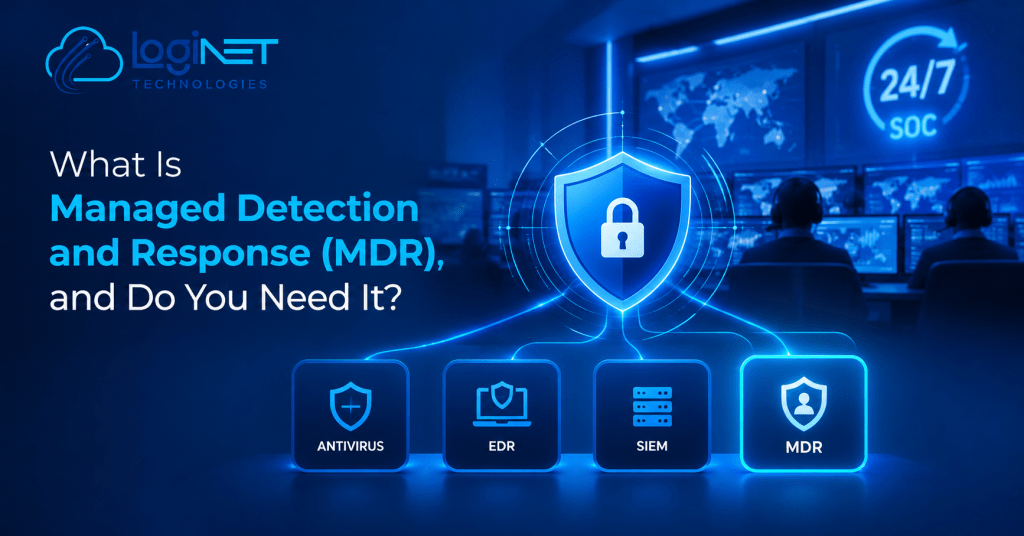
MDR vs Traditional Antivirus vs EDR vs SIEM, How They Layer Together
These terms get thrown around interchangeably, which causes most of the confusion. They’re not competing products, they’re layers that build on each other.
Traditional antivirus checks files against known malware signatures. It catches the obvious stuff and misses anything new or deliberately disguised. Endpoint Detection and Response (EDR) goes further, watching behaviour on each device continuously rather than just scanning files, so it can flag something acting suspiciously even if it’s never been seen before. SIEM (Security Information and Event Management) collects and correlates log data across your whole environment, not just endpoints, giving a wider view of what’s happening across the network.
Managed Detection and Response sits on top of all of it. It’s not a separate technology so much as a service, human analysts and automated tooling working together to actually watch what EDR and SIEM are flagging, decide what’s real, and act on it. Without MDR, a business with EDR and SIEM still has good visibility. What it’s usually missing is someone watching that visibility at three in the morning.
What a 24/7 SOC Actually Does When It Finds a Threat
A security operations centre, whether it’s an internal team or a managed one, exists to answer one question quickly: is this alert real, and if so, how bad is it. Most security tools generate a constant stream of alerts, and the overwhelming majority are false positives or low-priority noise. The value of a 24/7 SOC is triage, someone (or something) qualified enough to separate a genuine attack from routine background noise, at any hour, not just during business hours when your internal team happens to be logged in.
Once an alert is confirmed as a real threat, analysts investigate scope, how did the attacker get in, what have they touched, is this contained to one device or spreading, before deciding on a response. That investigation step is where the “human” part of MDR earns its cost. Automated tools are good at flagging anomalies, but deciding whether an anomaly is a genuine breach or a misconfigured backup job still benefits from a person who’s seen both before.
Automated Containment: What Happens in the First Minutes of an Incident
Speed matters more than almost anything else in security response. Research from IBM’s 2025 Cost of a Data Breach Report found the average global cost of a data breach reached $4.44 million, and separately that businesses without strong detection and response capability take an average of 241 days to identify and contain a breach. That gap, days or weeks rather than minutes, is exactly what MDR is built to close.
Quality MDR services lean heavily on automated containment for high-confidence threats: isolating an infected device from the network, disabling a compromised account, or blocking malicious traffic automatically, within minutes of detection rather than waiting for a human to manually action every step. Analysts still review and confirm what happened afterwards, but the containment itself often happens fast enough to stop lateral movement before it starts, which matters because attacks frequently unfold outside standard business hours, precisely when an internal team isn’t watching.
Signs Your Business Has Outgrown Basic Antivirus
A few honest signals that basic antivirus alone isn’t enough anymore:
- You’re storing or handling data that would be genuinely damaging if it leaked or was held for ransom
- You’ve had a close call already, a phishing click, a suspicious login, something that got noticed more by luck than by process
- Your business runs outside a strict nine-to-five, meaning threats arriving overnight or on weekends could sit unnoticed until someone’s back at their desk
- You’re subject to compliance obligations that expect documented, ongoing security monitoring, not just a scan that runs once a week
- Nobody on your team could confidently say what would happen in the first hour of a real incident
If more than one of those sounds familiar, the gap MDR is designed to fill is probably already costing you more in risk than it would cost to close.
Managed SIEM and EDR Services Queensland: What to Ask an MDR Provider Before Signing
Before signing with any MDR provider, a few questions cut through the marketing quickly. Ask exactly what “24/7” means in practice, whether that’s a genuine round-the-clock SOC or an on-call arrangement with a delay attached. Ask what response authority the provider actually has, can they isolate a device or disable an account themselves, or do they only notify you and wait for approval, because that difference matters enormously during an active incident. Ask how alerts are triaged and by whom, and ask what’s explicitly excluded from the service, since MDR doesn’t replace patching, backups, staff security awareness training, or a properly configured firewall. It works alongside those things, not instead of them, and any provider implying otherwise is oversimplifying what MDR actually does.
Businesses across Queensland looking at managed SIEM and EDR services should also confirm how the provider handles data residency and reporting, since compliance obligations often hinge on exactly where and how that monitoring data is stored and who can access it.
Frequently Asked Questions
Is MDR the same as antivirus?
No. Antivirus checks files against known threats and runs largely unattended. MDR is a full service built around continuous monitoring, human analysis, and active response, usually built on top of EDR and other detection tools rather than replacing them.
How fast does MDR respond to a detected threat?
It varies by provider, but the goal of a properly run MDR service is minutes, not days. That’s a meaningful contrast to the IBM-reported average of 241 days businesses take to identify and contain a breach without strong detection and response in place.
Does MDR replace the need for a firewall?
No. A firewall controls what traffic gets into your network in the first place. MDR monitors and responds to what happens once something’s already inside or already on a device. They work together, not as substitutes for each other.
What size business actually needs MDR?
There’s no strict headcount cutoff. The better question is whether your business handles sensitive data, operates outside standard hours, or has compliance obligations around security monitoring, any of which can make MDR worth it well before a business reaches enterprise size.
Get a free security stack review from Loginet, and we’ll tell you honestly whether MDR closes a real gap in your current setup, or whether what you already have is enough.