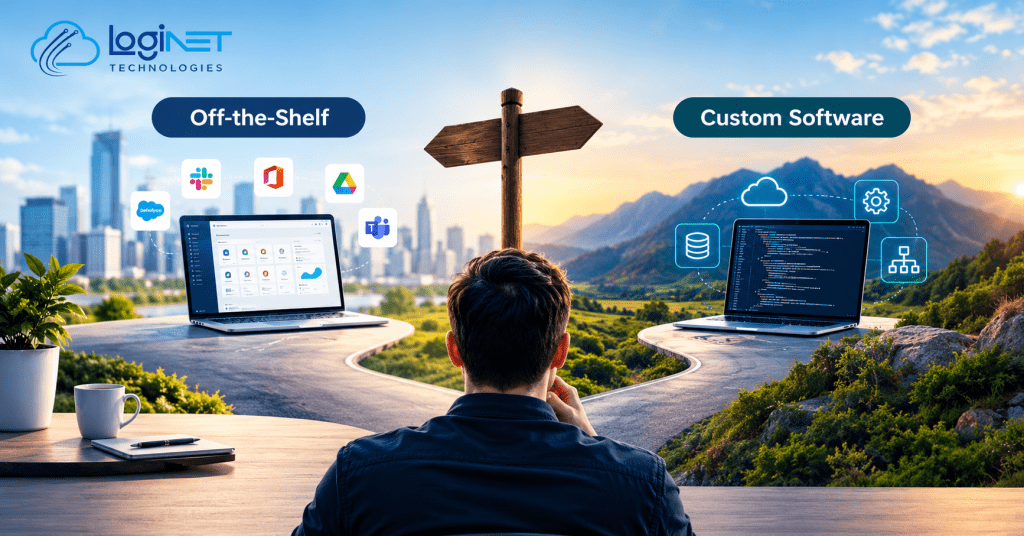
Custom Software vs Off-the-Shelf: How to Decide for Your Business
Should you buy off-the-shelf software or build something custom? Off-the-shelf software wins on speed and cost for standard processes, and custom software earns its higher upfront cost when your workflow, integrations or competitive advantage genuinely don’t fit a generic product.
That’s the short answer. The harder part is figuring out honestly which category your business actually falls into, because most owners assume their process is more unique than it really is, and a fair number assume the opposite too.
The Real Cost Difference Over 3-5 Years, Not Just Day One
Off-the-shelf software almost always looks cheaper on the day you sign up, and for a lot of businesses it stays that way. A subscription fee, maybe some setup time, and you’re running. Custom software has a bigger upfront number attached to it, and that’s the figure most business owners fixate on when comparing quotes.
The comparison that actually matters happens over three to five years, not on day one. Off-the-shelf tools charge per seat, and those costs climb as your team grows. They also tend to require workarounds once your business outgrows the way the software expects you to operate, and those workarounds cost staff time every single week, quietly, in a way that never shows up on an invoice. Custom software has no per-seat licence fee scaling against you, and it’s built around how your business actually works rather than the other way around, but it does carry ongoing maintenance and update costs that need to be planned for from the start, not discovered later.
Neither option is free to maintain. The real question is which cost structure suits how your business is likely to grow.
Questions That Reveal Whether Your Process Is Actually “Standard”
Most owners describe their process as unique before checking whether it actually is. A few honest questions tend to settle it quickly:
- Does a well-known product in your industry already do 80% or more of what you need, without heavy customisation?
- Are you bending your actual workflow to fit software, or is the software forcing extra manual steps to fit your workflow?
- Is the process you’re trying to support tied to something that genuinely sets your business apart from competitors, or is it just how you’ve always done it?
- Would a competitor running the exact same off-the-shelf tool be at any real disadvantage against you?
If the answers point to “this is basically what everyone in our industry does,” off-the-shelf is very likely the right call, and there’s no need to spend more just to feel like the solution is bespoke. If the answers point to a genuinely different workflow, one that’s core to how you compete, that’s where custom development starts to earn its cost.
Integration and Data Ownership Trade-Offs
This is where a lot of businesses get caught out after the decision is already made. Off-the-shelf software connects to other systems through whatever integrations the vendor decided to build, and if your combination of tools isn’t a common one, you may end up exporting spreadsheets by hand between systems that should be talking to each other directly.
There’s also a data ownership question worth taking seriously. With most off-the-shelf platforms, your data lives inside their system on their terms, and switching providers later can mean a genuinely painful export and migration process. Custom software gives you full ownership of your own data and the freedom to design integrations exactly the way your business needs them, our application modernisation services exist specifically for businesses trying to connect ageing systems that were never built to talk to each other. The trade-off is that you’re also responsible for keeping those integrations working as the systems on either end change over time.
Software Development Services Toowoomba: Offshore vs Local Development, What Actually Changes
Cost comparisons between local and offshore development usually stop at the hourly rate, and that’s genuinely the wrong place to stop. Offshore development can look considerably cheaper per hour, and for well-defined, self-contained projects with clear specifications, it can work perfectly well.
What tends to change with offshore development is communication overhead: time zone gaps that slow down back-and-forth questions, requirements that get lost in translation between how you described something and how it gets built, and support that isn’t available during your actual business hours when something breaks. Local software development services in Toowoomba and across Queensland mean someone who understands the Australian business environment you’re operating in, can meet face to face when a project genuinely needs it, and is reachable during the hours your business actually runs. That’s a real advantage for projects that evolve as they’re being built, which is most of them, rather than a marketing line about supporting local business.
A Simple Decision Framework
If you’re still weighing it up, this order of questions tends to cut through the noise fastest:
- Does an established product already solve 80% or more of the problem without heavy customisation? If yes, start there.
- Is the remaining 20% tied to something that genuinely differentiates your business? If not, live with the off-the-shelf limitation.
- Will you still be running this process in three to five years, at meaningfully larger scale? If yes, run the real long-term cost comparison, not just the day-one price.
- Does your business depend on data or integrations that no off-the-shelf product handles well? That’s usually the clearest signal that custom development is worth it.
Frequently Asked Questions
How much does custom software cost in Australia?
Real numbers rather than “it depends”: small internal tools typically start around $15,000, and complex enterprise systems can run past $500,000. Most standard business applications, the kind with a handful of integrations and multiple user roles, land in the $25,000 to $250,000 range. Developer rates currently sit around $180 to $250 an hour in Sydney and Canberra, $150 to $210 in Melbourne and Brisbane, and $130 to $190 in regional centres, so a Toowoomba-based project often costs meaningfully less than the same scope quoted out of a capital city.
Can custom software integrate with our existing systems?
Yes, that’s one of its main advantages over off-the-shelf tools. Custom development is built to connect directly with the systems you already run, including older or specialised software that off-the-shelf products typically can’t integrate with cleanly. Our custom web development work often starts exactly there, connecting a new front end to systems that already exist.
What’s the typical timeline for a custom build?
Timelines scale with complexity. A small, single-purpose tool or MVP typically takes around 8 to 14 weeks, a mid-complexity system with multiple integrations and user roles generally runs several months, and larger, heavily integrated platforms can extend well beyond that. A firm timeline comes once your specific requirements are scoped, not from a generic table.
Is local development worth the premium over offshore?
For projects with fixed, fully documented requirements and no need for ongoing changes, offshore can be a reasonable option. For anything that’s likely to evolve during development, or that depends on close, fast communication, most businesses find the local premium pays for itself in fewer misunderstandings and faster fixes.
Request a free software requirements consultation with Loginet, and we’ll give you a straight answer on whether custom development actually makes sense for your business, before you spend a dollar on either path.