Co-Managed IT vs Fully Outsourced IT: Which Model Actually Fits Your Business?
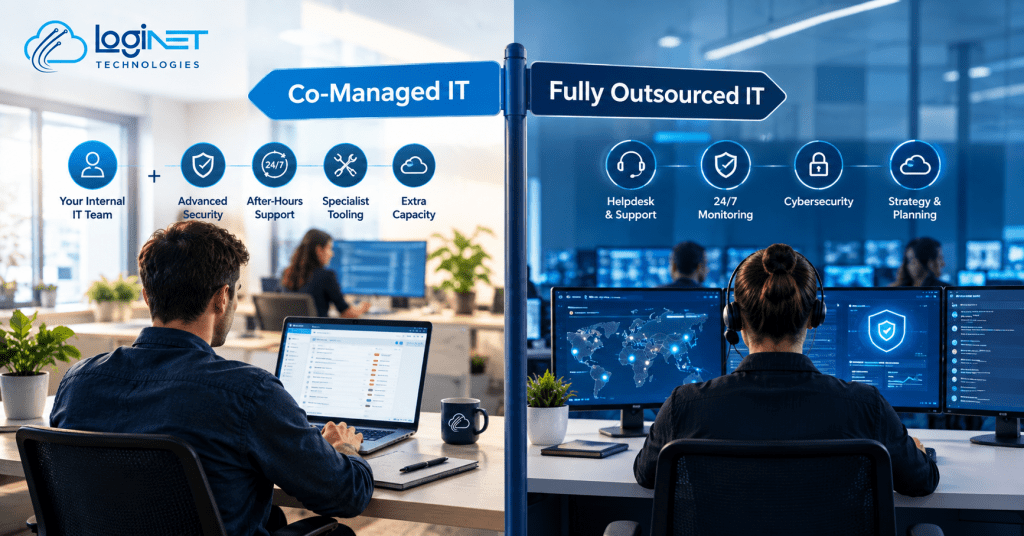
What’s the difference between co-managed IT and fully outsourced IT? Co-managed IT keeps your internal IT person or team in place and adds specialist backup, after-hours coverage and extra tooling around them, while fully outsourced IT replaces the internal function entirely. The right choice mostly comes down to whether you already have internal IT headcount, or want to.
That’s the short version. Here’s what actually separates the two models once you get past the label.
What Co-Managed IT Covers That a Solo IT Person Can’t
Picture a business running one internal IT person covering roughly forty staff. That one person handles the daily fires: password resets, printer issues, the odd server hiccup, the new starter who needs a laptop set up by Monday. What they usually can’t cover, because no single person realistically can, is 24/7 monitoring, deep cybersecurity tooling, a second set of hands during annual leave, or the kind of strategic planning that needs uninterrupted focus rather than fifteen minutes between tickets.
Co-managed IT services fill exactly that gap. Your internal person stays the first point of contact and keeps their institutional knowledge of how your business actually runs, while a managed provider adds the after-hours coverage, the specialist security monitoring, and the extra capacity for projects that would otherwise sit on a to-do list for months. It’s less a replacement and more a genuine extension of the team already there, giving your internal person backup rather than a rival.
What Fully Outsourced (Managed) IT Replaces
Fully outsourced IT takes the whole function off your plate. Instead of employing someone internally, a managed provider becomes your IT department, handling the helpdesk, monitoring, security, and strategy end to end. This tends to suit businesses without internal IT headcount at all, or ones that have decided the cost and hassle of hiring, training, and retaining IT staff internally isn’t worth it compared to a predictable monthly arrangement.
The trade-off is that you lose the person who knows your business from the inside. A good fully outsourced provider works to close that gap through documentation, regular check-ins, and a consistent team rather than rotating support staff, but it’s a genuinely different relationship to having someone sitting down the hall.
Cost Comparison: One Internal Hire vs Co-Managed vs Fully Outsourced
The numbers here matter more than the labels. A single internal IT support hire in Australia currently earns a median salary of around $87,724 a year, and that’s before adding superannuation, leave, equipment, training, and the recruitment cost of replacing them when they eventually move on. A more senior IT manager role, the kind capable of genuine strategic input rather than just day-to-day support, averages closer to $135,000. Either way, one internal hire is one person’s worth of coverage, with no backup built in.
Fully outsourced managed IT is typically priced per user per month rather than as a salary. Most Australian businesses currently pay between $120 and $250 per user per month for fully managed IT services, with the exact figure depending heavily on scope, security depth, and how mature the provider’s delivery actually is. For a 40-person business, that puts fully outsourced IT somewhere in the vicinity of $4,800 to $10,000 a month, again depending on what’s actually included.
Co-managed pricing is harder to pin to a single number, because by design it’s scoped around whatever gaps your internal team has rather than full coverage from scratch. It’s generally priced lower per head than fully outsourced IT, since your internal person is already handling the baseline day-to-day work, but the real figure depends on exactly what’s being added: after-hours monitoring only, full security tooling, or something closer to a genuine partnership across the board. A proper quote needs your actual environment in front of it, not a generic per-user rate.
Signs You’re a Co-Managed Fit vs a Fully-Outsourced Fit
Co-managed tends to make more sense when:
- You already have a capable internal IT person or small team you want to keep, not replace
- That person is stretched thin on security, after-hours coverage, or specialist areas outside their core skills
- You want to retain internal institutional knowledge while adding depth around it
Fully outsourced tends to make more sense when:
- You have no internal IT headcount and don’t want to build it from scratch
- Hiring and retaining IT staff has been difficult or expensive in the past
- You’d rather have one predictable monthly cost than manage a mix of salary, tools, and vendor relationships yourself
How the Transition Works Either Way
Moving into either model usually starts the same way: an audit of what’s currently running, what’s working, and what’s quietly not. From there, co-managed engagements typically layer new tooling and after-hours coverage around the existing setup with minimal disruption, since the internal person is still there acting as a constant through the change. Fully outsourced transitions take longer to bed in, since a new provider needs to build the documentation and institutional knowledge an internal hire would already have, but a properly run transition keeps that period short and structured rather than leaving gaps.
Co-Managed IT Support Toowoomba: What Local Delivery Adds
Businesses across Toowoomba and the surrounding region choosing between these two models often find the local factor matters more in a co-managed setup than a fully outsourced one, mainly because co-managed IT depends on close, regular coordination between your internal person and the provider’s team. Being reachable during actual business hours, and available on-site when something genuinely needs hands rather than a remote session, tends to make that coordination smoother than a purely remote, interstate arrangement would.
Frequently Asked Questions
Does co-managed IT replace my current IT person?
No, that’s the core difference from fully outsourced. Co-managed IT is built specifically to work alongside your existing internal person or team, not instead of them.
Can we switch from co-managed to fully outsourced later?
Generally yes, particularly if your internal IT person moves on and you decide not to backfill the role. A provider already familiar with your environment through a co-managed arrangement usually has an easier transition to full management than starting from scratch with someone new.
What does co-managed IT typically cost per month?
It varies more than fully outsourced pricing, since it’s scoped around your specific gaps rather than full coverage. As a reference point, fully managed IT in Australia currently runs $120 to $250 per user per month, and co-managed engagements are generally priced below that since your internal team already covers part of the workload. A specific figure needs your actual environment assessed first.
Who owns IT strategy under a co-managed model?
This should be agreed explicitly at the start rather than left ambiguous. In practice, it’s often a shared responsibility, with your internal person retaining day-to-day ownership and ongoing input, while the managed provider contributes strategic and security expertise the internal team may not have in-house.
Book a co-managed IT fit assessment with Loginet, and we’ll give you a straight answer on whether co-managed or fully outsourced actually makes sense for your team, based on what you’re already running rather than a generic pitch.