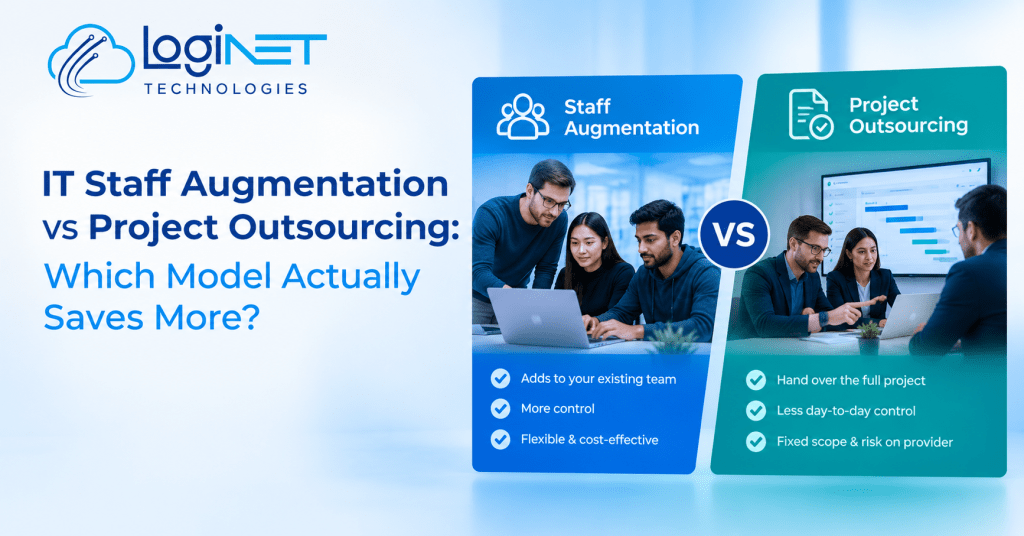
IT Staff Augmentation vs Project Outsourcing: Which Model Actually Saves More?
Is it cheaper to augment your team or outsource the whole project? IT staff augmentation is usually the more cost-effective route when you already have technical leadership in place and just need extra hands. Fully outsourcing a project makes more sense when you lack the internal capacity to manage delivery at all, not just the headcount to build it.
That’s the direct answer. The real comparison depends on numbers most businesses never actually run before choosing, so here they are.
What Staff Augmentation Actually Gives You (vs a Contractor Marketplace)
IT staff augmentation means adding contract professionals directly into your existing team, working under your management, your processes, and your project lead. This is a meaningfully different arrangement to pulling someone off a general contractor marketplace, where you’re hiring an individual with no ongoing relationship to a delivery partner and no backup if that person turns out to be a poor fit.
Done properly, staff augmentation includes vetting before placement, a genuine backup option if a contractor doesn’t work out, and someone on the provider’s side who stays accountable for the placement rather than disappearing once the invoice is issued. You get the flexibility of contract labour with less of the risk that comes from hiring blind off an open marketplace.
What Project Outsourcing Takes Off Your Plate
Project outsourcing works differently. Instead of adding people to your team, you hand over an entire piece of work, scope, delivery, and often project management, to an external provider who delivers a finished result. You’re not managing day-to-day tasks or supervising individual contributors, you’re managing a relationship and a set of milestones.
This suits businesses that don’t have the internal capacity to direct technical work at all, not just businesses short on hands. If nobody internally can specify requirements clearly, review technical output, or make the calls a project lead needs to make daily, staff augmentation won’t solve that problem, because augmented staff still need direction from someone on your side.
Cost Comparison Over a 6-Month Project
Here’s where the numbers matter more than the labels. Current Australian contractor day rates vary significantly by role and seniority:
| Role type | Typical AU day rate (2026) | Source |
|---|---|---|
| Application/service desk support | $280–$550/day, varies by region | Hays Technology Contractor Rates, via ARN |
| Mid-level developer / ERP-CRM developer | $910–$1,095/day | Hays Technology Contractor Rates, via ARN |
| Cyber security analyst | $720–$800/day | Hays Technology Contractor Rates, via ARN |
| Cloud Architect | around $1,448/day | Talent International, Top 10 Contractor Day Rates 2026 |
Applying that to a real scenario: bringing in one mid-level developer through staff augmentation for a 6-month project, roughly 125 working days, at $950/day sits around $118,750, invoiced directly with no separate on-costs for you to manage, since super, leave, and equipment are already the contractor’s or their agency’s responsibility.
Project outsourcing for the same piece of work is priced differently, usually as a fixed price or milestone-based fee covering the whole deliverable rather than a day rate, which makes a direct dollar-for-dollar comparison difficult by design. The honest trade-off isn’t really about which number is smaller. It’s about where the risk sits: staff augmentation means you pay for the days regardless of how efficiently the work goes, while a fixed-price outsourced project shifts that overrun risk onto the provider, in exchange for a premium built into the quote to cover it.
Staff Augmentation Services: Risk and Control Trade-Offs
Staff augmentation services keep control with you. You direct the work, set priorities day to day, and can redirect effort the moment something changes, but that also means the delivery risk sits with you. If the project runs long, you’re paying for extra days. If requirements were unclear from the start, that’s on your side to fix, not the contractor’s.
Outsourcing shifts that risk to the provider in exchange for less day-to-day control. You’re not directing the work yourself, you’re reviewing outcomes against agreed milestones, which suits businesses comfortable stepping back from the technical detail but less comfortable ones that want visibility into exactly how something’s being built as it happens.
A Quick Self-Assessment to Pick the Right Model
A few honest questions tend to settle it:
- Do you already have someone internally capable of directing technical work day to day? If yes, augmentation likely fits better.
- Is the project scope and outcome well-defined enough to hand off entirely? If yes, outsourcing becomes more viable.
- Do you need flexibility to scale the team up or down as the project evolves? Augmentation handles that more naturally than a fixed-price contract.
- Would your business struggle to absorb a schedule overrun cost? That points toward outsourcing, where overrun risk sits with the provider instead.
Frequently Asked Questions
Does staff augmentation include management of the contractor?
Day-to-day direction of the work stays with you, since that’s the point of augmentation, adding capacity under your existing management. What a good provider still manages is the placement itself: vetting, replacement if there’s a poor fit, and remaining accountable for the person they’ve placed.
How fast can augmented staff start?
This depends on role seniority and current market availability for that specific skill set.
What happens if a contract role isn’t a fit?
A properly structured staff augmentation arrangement includes a replacement process if a placement genuinely isn’t working out, which is one of the clearest advantages over hiring an individual contractor directly off an open marketplace with no support behind the placement.
Can augmentation convert to a permanent hire?
Often yes, and it’s a common path for businesses that want to trial someone in the role before committing to a permanent position. Terms around conversion should be agreed upfront rather than assumed partway through the engagement.
Talk to us about your resourcing gap, and we’ll help you work out honestly whether staff augmentation or a fully outsourced project actually fits what you’re trying to get done.