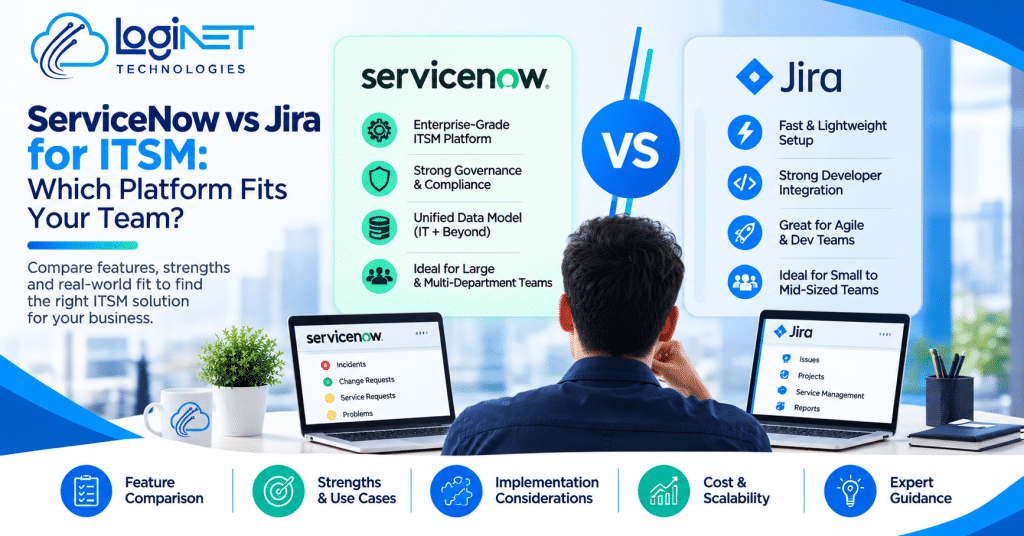
ServiceNow vs Jira for ITSM: Which Platform Fits Your Team
If you’re a small team that works next to developers, Jira Service Management is probably your answer. If you’re a bigger business with strict approval rules and several departments that will all want the same system, it’s probably ServiceNow. And if neither sounds like you, keep reading, because plenty of businesses sit awkwardly in the middle.
This might sound odd coming from us, but the platform matters less than you’d think. When someone asks about ServiceNow implementation consulting, the first few conversations tend to be about other things: who handles requests today, where approvals happen, what the data looks like. Sometimes the honest answer is “not yet”. Our IT consulting team would rather say that up front than sell you something you can’t use.
The basic difference
ServiceNow began as a workflow platform, and ITSM is one product on it. Incidents, changes, problems and requests all connect to one configuration database, so a change request can show what it might knock over. (ServiceNow ITSM overview)
Jira Service Management is Atlassian’s offering, and if you’re weighing up a Jira ITSM platform it helps to know it grew up alongside the developer tools, so it’s most at home when the people fixing things and the people building things are passing tickets back and forth. Atlassian’s own pitch is about getting development, IT support and operations working together. (Atlassian ITSM overview)
Day to day, both will log an incident, run a request through an approval and keep a knowledge base. It’s when your setup gets a bit unusual that you start to feel which one was built for you.
Where ServiceNow pulls ahead
Governance, mainly. If an auditor wants to know who signed off a change and why, or you’ve got a few sites all doing things their own way, ServiceNow is made for that. Jira can do change management as well, especially when changes link to deployments, but every extra rule means more setup and more add-ons.
Mind you, software won’t write your rules for you. That’s a job for IT governance consulting, and if nobody has decided who approves what, either platform will just record the argument.
Where Jira pulls ahead
Speed and weight. With a small team you can often have Jira Service Management humming along without hiring a soul, and because it plays nicely with the developer tools you probably use already, there’s less for everyone to learn. Once you’ve got ten or twenty people sharing a queue, that counts for more than any feature list.
Who looks after it
Nobody seems to ask this until the project’s finished and the consultants have left the building. ServiceNow tends to want someone with proper platform skills, whether that’s an admin on your payroll or a partner you ring when something breaks, whereas Jira is light enough that a lot of teams just get on with it using whoever they’ve got.
Whichever way you lean, sort out who owns it before you sign anything. Maybe that’s the IT support crew you already have, maybe a managed IT services provider steps in, or maybe an outsourced help desk takes the first-line calls so your own people can stay on the trickier jobs. All reasonable. Having no answer at all is the problem.
Tools you already run
If your developers already spend their days in Jira, putting support tickets in the same place cuts out a surprising number of clumsy handovers. ServiceNow will connect to most of what you run too, it’s just that each connection becomes its own little project, and somebody has to keep an eye on it afterwards. Both come as cloud products, so if all this is part of a bigger move, it makes sense to line it up with your cloud solutions work instead of leaving it as a side job.
What the project involves
The install is the quick part, and it’s rarely where things go wrong. The hours go into agreeing how your team really works (as opposed to how the process document says it does), tidying the configuration data your workflows will lean on, setting up roles and approvals, and then persuading people to use the thing. Skip all that and you’ll have a good-looking system sending tickets to the wrong people, very efficiently.
Which is why we’d rather begin with a roadmap than a quote. A bit of technology roadmap consulting up front tells you whether ITSM belongs at the top of the list or well down it, and what needs to be true before a platform this size is worth the effort. And if you’re partway through digital transformation in Queensland, the order of things matters even more, since the service desk almost never changes in isolation.
Cost
It’s easy to fixate on the licence price, but the real bill also takes in setup effort, admin time, add-ons, training and the steady trickle of changes after go-live. With Jira Service Management, look closely at which plan includes the incident, change and problem features you’re after, because the cheapest tier may leave some out. With ServiceNow, ask plainly what’s in the base package and what gets sold on top.
Choosing between them
When you get to ITSM platform selection, a rough scoring exercise will do you more good than a string of sales demos. Write down how formal your processes are, how many people you can realistically spare to run it, what you’re already tied to, and whether other departments are likely to want in within a few years. Formal and audited leans ServiceNow. Fast and developer-heavy leans Jira. Spare capacity often breaks the tie.
Then run a pilot with real tickets for a couple of weeks. You’ll learn more from that than from any sales presentation. And whoever you bring in for IT strategy consulting in Australia should weigh all this against your actual budget and staff, not push a favourite.
Common questions
Can a small business use ServiceNow?
Technically yes, though many small teams find it more than they need. With a handful of agents and nobody to take on the admin, Jira Service Management usually gets going sooner, and who’ll look after it matters far more than your headcount.
Can we start on Jira and switch to ServiceNow later?
You can, and a lot of businesses do. It does mean moving tickets, knowledge articles and configuration data across and rebuilding your workflows, so set some time aside. If your processes are written down and your data’s reasonably tidy from the start, the move gets a good deal easier.
How long does an ITSM rollout take?
That depends on how much you turn on at the start and what shape your data’s in. A basic service desk can be live fairly quickly, but change approvals and a full configuration database take a good while longer, so most teams are better off rolling it out in stages.
If you’re still undecided
Broadly, Jira wins on speed and a lighter footprint, while ServiceNow earns its place when you need tight governance and one system shared across departments. Pick whichever one your team can genuinely run and you’ll be in good shape.
If you’d like a straight opinion, drop the Loginet team a line. A short conversation about your processes, tools and people is normally enough to show which way to lean, and there’s no obligation to take it any further. Which of those questions is the hardest one for your team at the moment?