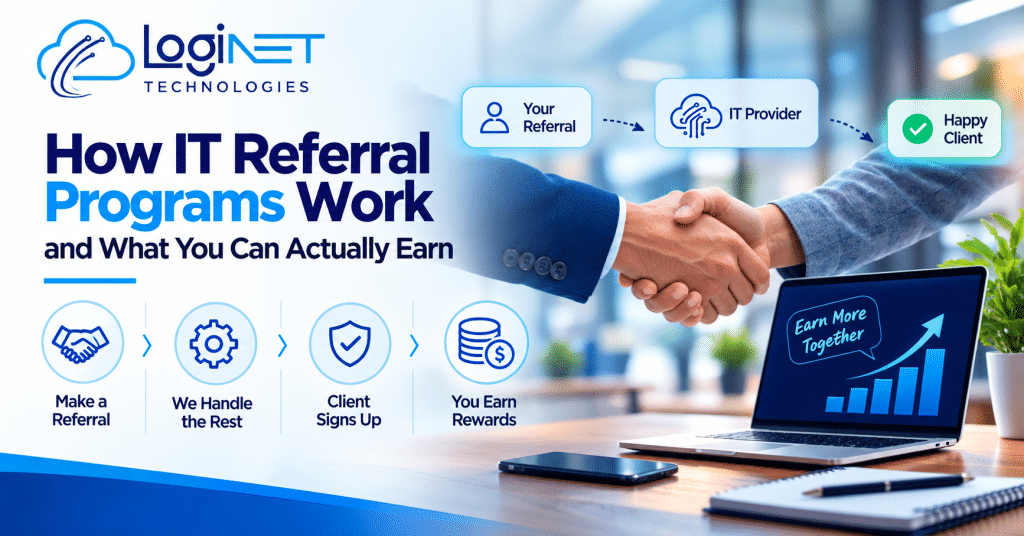
How IT Referral Programs Work and What You Can Actually Earn
A referral program for IT services pays you when you introduce a business that goes on to hire the provider. You make the introduction, the provider runs the sales conversation and does the work, and if the client signs, you receive a reward for connecting the two. The amount isn’t fixed across the industry. Each program sets its own terms, so ask for them in writing before you refer anyone, and treat any figure quoted without those terms as a guess.
That’s the short version. The rest of this article covers what happens between the introduction and the payment, where the money tends to come from, and what to ask before you take part.
What happens after you make an introduction
Think of it as a hand-off with a paper trail. You know a business owner who is struggling with something IT related: a network that keeps dropping out, a software project that has stalled, a team that has outgrown its makeshift setup. You mention the provider, and with the owner’s permission you pass on their details.
From there, the provider takes over. Someone gets in touch, asks about the problem, and works out whether they can genuinely help. This is where you step back. A good referral partner doesn’t sit in on sales calls or negotiate scope, because that is the provider’s job, and the client tends to trust the process more when it stays clean.
The paper trail matters because it settles who introduced whom. Programs log the referral when it’s submitted, usually through a form or a direct message, so that if the client signs three weeks or three months later there’s a clear record of where they came from.
If the client signs, the reward is triggered. If they don’t, nothing is owed, and you haven’t lost anything either, apart from the goodwill of having tried to help.
What you can actually earn
No two programs pay the same way, and anyone who quotes you a figure without seeing the terms is guessing. Broadly, rewards come in a few forms.
A one-off payment is the simplest. The client signs, the provider pays a fixed amount or a percentage of the first project, and that’s the end of it. A recurring commission pays a share of what the client spends over time, which suits managed services and ongoing support where the relationship can run for years. Some programs pay in credit or services rather than cash. In practice, a referral bonus from an IT company is usually one of the first two, and which one applies, and how it’s calculated, is exactly what you need to pin down.
Two things affect the real value more than the headline rate. The first is what the reward is calculated on: the first invoice, the first year, or the life of the relationship. The second is when it’s paid: on signing, on the client’s first payment, or later. A generous-looking percentage that arrives after a long delay can be worth less than a smaller amount paid promptly.
There’s also the practical side. If you earn commission referring clients as part of a business or a side income, there may be tax and reporting obligations, and your accountant is the right person to ask about those.
What makes a referral worth making
Money aside, the referrals that convert are the ones where the fit is real. A business with a genuine IT problem, a budget to solve it, and someone with the authority to say yes will move quickly. A hunch that a business could probably use some IT help rarely turns into a signed client.
Before you refer someone, it helps to check three things. Does the person actually want the introduction? Never hand over someone’s details without asking. Is the problem one the provider works on? And can you describe the need in a sentence or two? That last point lets the provider open the conversation properly instead of starting cold.
Your reputation is attached to every introduction. Send a poor fit, or a business that wasn’t expecting the call, and it reflects on you as much as on the provider. So the incentive to be selective is built in, which is a good thing for everyone involved.
Referral partner, agent or reseller: what’s the difference?
The terms get muddled, and companies use them differently, so check what a given program means by each one. Broadly, a B2B referral partner program is about introductions: you connect people, and the provider handles everything after that. An agent arrangement usually involves a closer relationship, where you play a more active part in bringing clients to the provider over time. A reseller relationship is different again, because it typically involves selling the provider’s services under a defined arrangement, and an IT reseller referral sits somewhere between the two.
Some providers also run a partner rewards program IT teams and advisers can join if they refer regularly, with benefits that build up over time rather than a single payment per client.
An IT consulting referral program follows the same basic logic, though consulting engagements often begin with a scoping stage, so the gap between introduction and signed work can be longer. That affects when you’re paid, which is one more reason to ask about timing early.
Loginet offers more than one way in. If you’d rather make the occasional introduction, the referral program is the simpler route. If you want a more active role, you can look at becoming one of our agents.
A few questions people ask
Do I need to work in IT to take part?
Not necessarily. Referrals often come from accountants, business advisers, office managers and others who hear about technology problems before anyone else does. What matters is that you know a business that could use the help and that you’re comfortable making the introduction.
Does the client pay more because I referred them?
It shouldn’t. In a properly run program, the reward is the provider’s cost of winning new business, not an extra line on the client’s invoice. Some people call this refer and earn IT services, which is a fair summary: you earn for the introduction, and the client deals with the provider on the provider’s normal terms.
When do I get paid?
That depends on the terms. Programs commonly tie payment to the client signing or making their first payment, but this varies, so ask before you refer.
Want to talk it through?
If you have a business in mind, or you just want to understand how this would work before deciding anything, get in touch with Loginet Technologies. There’s no obligation and no pressure. Ask your questions, hear how it works in practice, and take it from there. You can also read more on our referral program page first if you’d prefer to look around before reaching out.