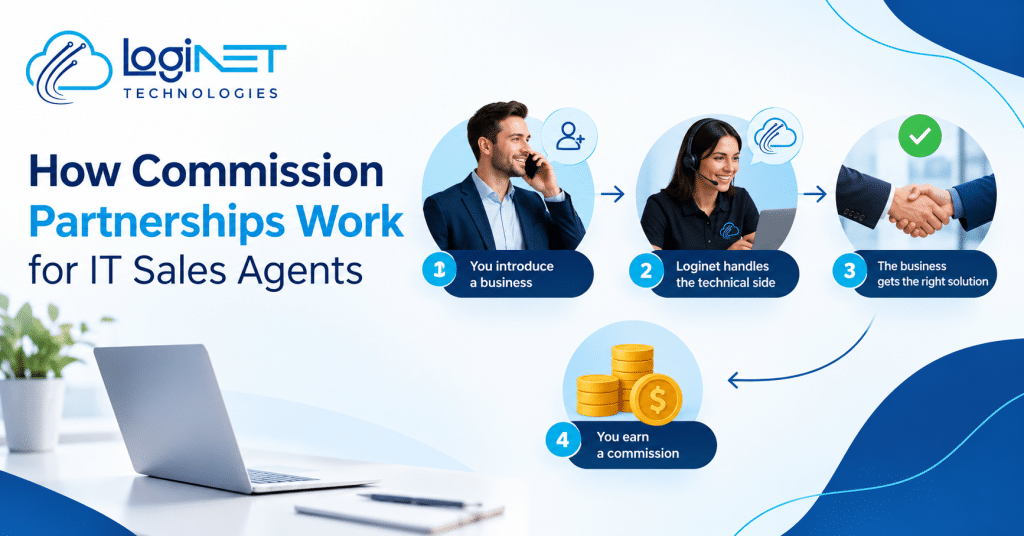
How Commission Partnerships Work for IT Sales Agents
You introduce a business to Loginet, we handle the technical side of the conversation, and you earn a commission on what closes. That’s the shape of it. No need to explain firewalls or cloud migrations yourself; your job is the introduction, ours is the delivery.
This article walks through how that actually works day to day: what an agent does, how leads move through the process, and how commission gets calculated and paid. If you’re ready to see the formal terms, they’re on the become our agent page.
How this kind of arrangement actually works
Strip away the jargon and an IT consulting affiliate program is a referral relationship with structure around it. You’re not selling IT services yourself, and you’re not expected to know the technical detail of what’s being proposed. You’re connecting someone who has a technology problem with a provider who can actually solve it, and getting paid when that connection turns into business.
This suits people who already talk to business owners for other reasons. Accountants, bookkeepers, business coaches, insurance brokers, even other consultants who don’t do IT themselves. If you hear “our IT’s a mess” or “we’re getting quotes for a new system” in the course of your normal work, that’s the moment this matters.
How to become a sales agent for IT services with Loginet
Getting started is simpler than most partner programs make it sound. You register your interest, have a short conversation about how you work and who you talk to, and get set up with whatever’s needed to pass a lead through, usually a simple form or a direct contact point. There’s no need to sit through hours of product training before your first introduction.
From there, the process runs in a fairly predictable loop.
| Step | What happens | Who’s involved |
|---|---|---|
| 1. Introduction | You flag a business that might need IT help | You |
| 2. Handover | Details get passed to Loginet, briefly and simply | You and Loginet |
| 3. Conversation | Loginet speaks with the business directly | Loginet |
| 4. Proposal | A scope and quote are put together if it’s a fit | Loginet |
| 5. Outcome | The business signs on, or doesn’t | The business |
| 6. Commission | If it closes, your payment is calculated and paid | Loginet |
How the IT sales agent commission program actually pays out
This is usually the first question, and fairly enough. The exact percentage and payment timing are commercial terms specific to Loginet’s arrangement, so ask directly rather than assuming a figure. What’s true across most programs like this is that commission is tied to the value of what’s signed, paid once the client relationship is confirmed rather than at the point of introduction, and structured so you’re not chasing invoices to get paid.
It’s also worth asking whether commission is one-off or ongoing. Some technology consultancy partner programs pay a single amount for a signed deal. Others pay a smaller ongoing share for as long as the client stays, which rewards agents for referring the right kind of long-term client rather than just any lead. Loginet’s referral program is worth reading alongside this one, since referral and agent arrangements aren’t always the same thing and it’s worth understanding the difference before you commit to either.
What makes a good referral
Not every lead is a good one, and a decent agent learns to spot the difference. A business that’s actively frustrated with its current IT, growing fast enough that its systems are creaking, or facing a compliance requirement it can’t ignore, that’s a stronger introduction than a business that’s simply “thinking about it someday.” You don’t need to qualify the technical fit yourself. You just need to notice when someone’s actually feeling the pain, not making small talk.
Geography matters less than it used to, since a lot of IT support work runs remotely, but an IT sales agent in Queensland, including the Darling Downs and Gold Coast regions where Loginet already operates, tends to have an easier first conversation because there’s a local connection to point to.
What you’re not responsible for
This is worth being explicit about, because it’s the part that puts people off unnecessarily. You’re not responsible for scoping the technical work, writing the proposal, negotiating price, or managing the relationship once it’s signed. That’s Loginet’s job. Your role stops at a genuine, well-placed introduction, and picks back up only when it’s time to calculate what you’re owed.
That also means there’s no ongoing workload attached to being part of this. This isn’t a channel partner program in Australia that expects you to resell hardware or hold stock, and it isn’t a technology reseller agreement either, since you’re never the one invoicing the client. Plenty of agents run this as a side arrangement alongside their main work, and commission-based IT sales suit people who’d rather earn from introductions than carry a sales quota.
Questions worth asking
Do I need any technical background to become an agent?
No. You need to be comfortable spotting the signs that a business needs IT help, and confident making an introduction. The technical conversation is handled by Loginet from that point on.
How is this different from the referral program?
The two overlap, but they’re not identical arrangements. It’s worth checking both pages and asking directly which structure fits how you work, since the commitment and payment structure can differ between them.
Is there a minimum number of leads I need to send?
Program requirements can vary between agents, so this is worth asking directly rather than assuming there’s a fixed quota either way.
Where to go from here
In short, becoming an agent means making the introduction and letting Loginet do the rest, with a commission when it results in real business. What kind of business owners do you talk to who might actually benefit from this?
If that sounds worth exploring, have a look at becoming an agent or get in touch to ask a question first. No pressure, just a straightforward conversation.