MSP Provider Australia: Cost vs In-House IT
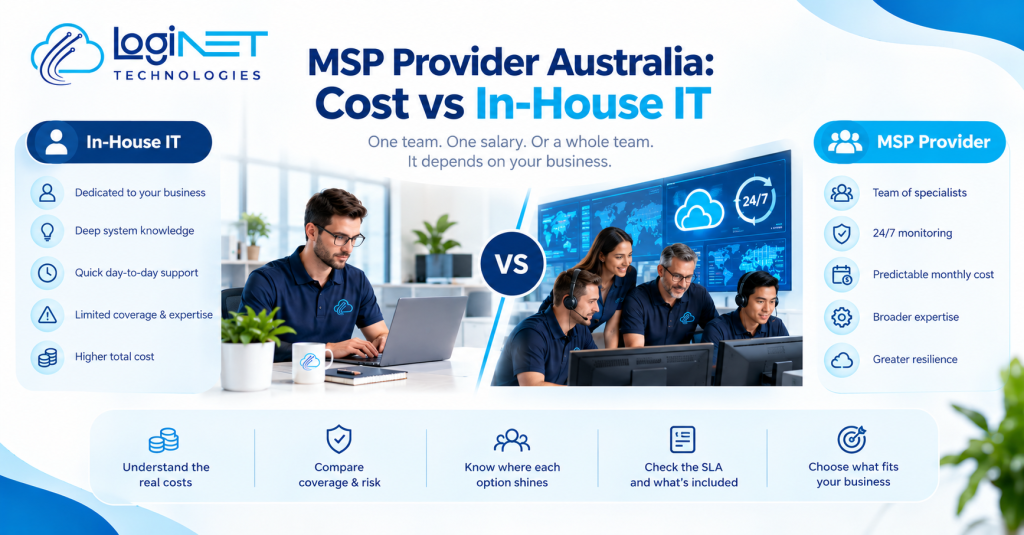
MSP provider Australia options exist for one main reason: an in-house hire gives you someone permanently on-site who knows your business inside out, while an MSP gives you a team’s worth of coverage and skills for roughly what one salary costs. Neither wins outright. It depends on what your business needs covered, and when.
This article walks through the real cost categories and the coverage gaps most businesses don’t think about until they hit one. If you’d like to see what managed IT services in Toowoomba actually look like in practice, the managed IT services page has the detail.
What “cost” actually includes
A single IT hire’s cost is never just the salary. Add super, leave, training, the licences and tools they need, and whoever covers their desk when they’re off sick. Exact salary bands shift by region and experience, so check those against current market data rather than treating anything here as fixed. The pattern holds regardless: the real cost of one employee always runs well above the number on the offer letter.
An MSP works differently, mostly because you’re not building that stack hire by hire. It’s usually a monthly fee that already has a team’s coverage, tools and expertise baked in. Doesn’t mean it’s automatically cheaper. It does mean the number’s easier to plan around when you’re trying to budget more than a quarter out.
Coverage: what one person can’t do alone
This is where the comparison gets more interesting than a simple dollar-for-dollar exercise. One in-house IT person, however good, has one set of specialties, one set of working hours, and exactly one body. If your network goes down at 2am, or your specialist happens to be on the one week of leave they’ve taken all year, coverage depends entirely on that single person’s availability.
An MSP provider in Australia typically spreads that risk across a team, which means 24/7 IT infrastructure monitoring is realistic in a way it rarely is for a single hire, since nobody expects one employee to be awake and watching servers overnight, every night. It also means when a problem needs a specialist in security, networking or cloud infrastructure, you’re not limited to whatever your one hire happens to know well.
| Factor | In-house IT | MSP |
|---|---|---|
| Coverage hours | Limited to one person’s working hours, unless you roster shifts | Often 24/7 monitoring built into the service |
| Breadth of expertise | Whatever that individual knows | A team spanning multiple specialties |
| Cost predictability | Salary plus overheads, can shift with hiring and turnover | Generally a fixed or predictable monthly fee |
| Continuity | Single point of failure if they’re away or leave | Team-based, less dependent on one person |
| Business context | Deep, first-hand knowledge of your systems and people | Builds context over time, but starts from outside |
| Response to niche issues | Depends on that person’s specific experience | Escalation to the right specialist within the team |
Where in-house genuinely wins
It’s worth being fair here, because in-house isn’t the weaker option in every scenario. Someone sitting inside the business day after day builds a depth of institutional knowledge that’s hard to replicate from outside: who’s difficult to work with, which system nobody trusts, why a particular workaround exists. They’re also immediately available for the small, constant interruptions that don’t justify a support ticket, the “can you just look at this for two minutes” requests that add up.
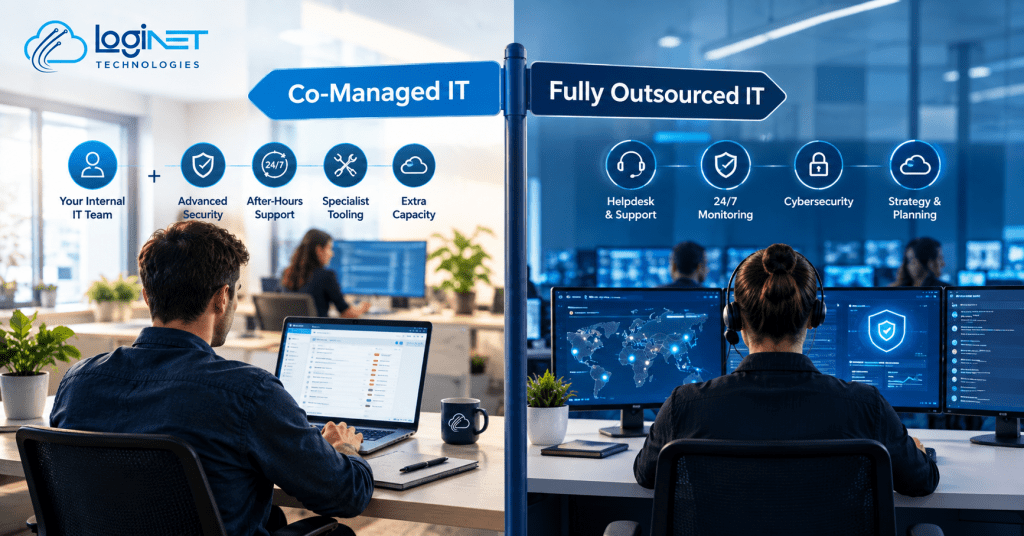
Larger businesses with genuinely complex, unique systems sometimes need that dedicated depth more than they need breadth. And for some businesses, the answer isn’t strictly one or the other. Co-managed IT keeps an internal person handling daily hands-on work while an external team covers planning, security and overflow capacity, combining the strengths of both rather than forcing a choice.
Where an MSP genuinely wins
An MSP tends to win on resilience and breadth. Proactive vs reactive IT support is part of this: most MSP agreements are built to catch problems early through monitoring and patching, rather than waiting for something to break and then responding. That’s harder to sustain with one internal person who’s also handling day-to-day requests and can’t watch everything at once.
Business IT support plans through an MSP also tend to include documented processes and reporting that survive staff turnover. If your in-house IT person leaves, so does a lot of undocumented knowledge about how things actually work. An MSP arrangement is built to be less dependent on any one individual staying put.
What IT SLA Australia standards actually protect you from
Whichever direction you go, it’s worth understanding what you’re actually promised. An SLA with an MSP sets out response times and coverage expectations in writing, something an internal hiring arrangement rarely formalises in the same way. If you’re comparing options, ask each MSP for their actual SLA terms rather than a general pitch, and compare that against what realistic in-house coverage would look like for your business specifically.
Some businesses also weigh a related option: IT outsourcing for specific functions, keeping certain things internal while handing off others, which sits somewhere between fully in-house and a full MSP arrangement.
Questions worth asking yourself
Is my business too small to justify a full-time IT hire?
Often, yes, if your IT needs don’t add up to a genuinely full-time job. An MSP or co-managed arrangement can fill the gap without carrying the overhead of a role that’s only half-utilised.
What happens to continuity if my one IT person leaves?
Honestly, it can hurt. Ask yourself how documented your current systems actually are, and whether that knowledge lives in someone’s head or somewhere your business could access without them.
Can I combine both approaches?
Yes, and plenty of businesses do. A co-managed setup lets you keep the in-house relationship and institutional knowledge while adding external coverage, specialist skills and proactive monitoring on top.
Where to go from here
So in short: the right choice comes down to how deep your IT needs are versus how broad, and how much risk you’re comfortable carrying on one person’s shoulders. Which matters more to your business right now, deep institutional knowledge or broad, resilient coverage?
If you’d like to talk through what fits your situation, get in touch and we’re happy to walk through the real trade-offs, not just a sales pitch.