Network Operations Center Services: What They Actually Do for Your Business
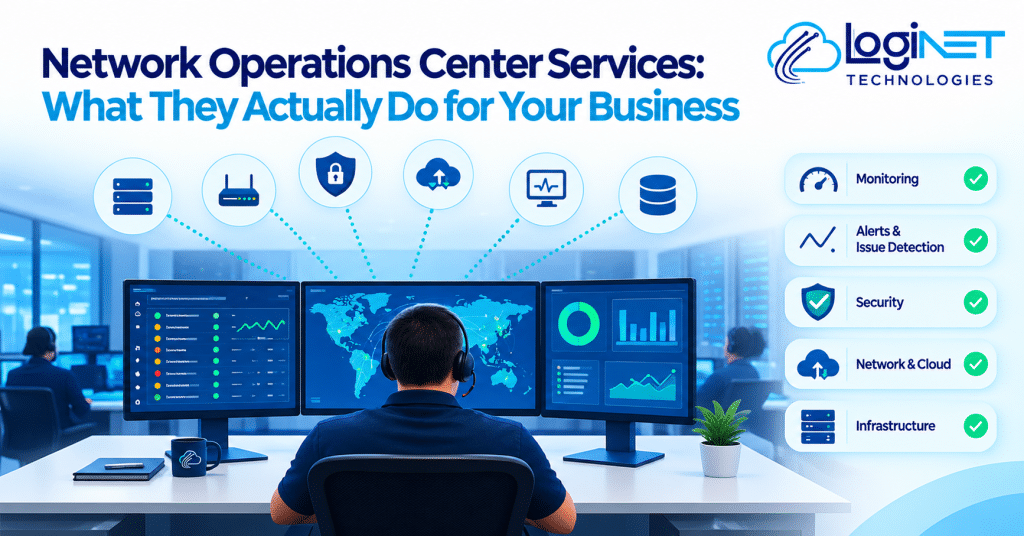
A NOC watches your servers, network and cloud setup around the clock. Picks up trouble early, well before it turns into an actual outage. Network Operations Center services exist for one reason really, so your business isn’t the one finding out something’s broken.
Most owners hear “NOC” and think enterprise-only, something for companies running their own data centre. Wrong assumption. Any business with systems that matter day to day needs someone watching them. Dedicated team with real telemetry, or whoever in the office notices the internet’s gone slow first. Those are the only two options, really.
What a NOC Actually Watches, and How
Continuous automated telemetry, not spot checks. That’s the short version. Several collection methods running together, each one covering a different layer of what’s happening on your network right now.
SNMP polling pulls status from switches, routers, firewalls, on a schedule. Interface errors, CPU load, hardware temperature, that sort of thing. Syslog aggregation pulls event logs into one place, so a pattern across fifteen separate logs actually becomes visible instead of fifteen meaningless entries sitting in fifteen different systems. NetFlow and sFlow show actual traffic flows, useful the moment bandwidth spikes and nobody can explain why. WMI goes deeper into Windows server health specifically. API-driven RMM connectors bring everything together in a single dashboard, which means nobody’s stuck juggling five separate vendor logins that never actually get checked.
Mid-market setups commonly run this kind of monitoring through platforms like Auvik, LogicMonitor, Datadog, NinjaOne or FortiManager. Different strengths each, network discovery versus infrastructure metrics versus security policy, same underlying job. Turn raw signals into something a human can actually act on. Remote monitoring tools generate the alerts. A person still decides what they mean.
How a Problem Gets Caught Before It Becomes an Outage
Most outages build slowly. Rarely happen all at once. A disk fills over days, quietly. A switch’s error rate creeps up before it finally drops packets badly enough that someone notices. A scheduled backup fails without a sound, and nobody knows until a restore’s actually needed and it isn’t there.
A NOC that’s actually doing its job catches that early signal. Disk trending toward full. A traffic pattern that’s slightly off. A service answering slower than its usual baseline. Spotting trouble while a system’s still at 60 percent beats finding out once it’s hit 100 percent and failed outright, with the business already down and customers already ringing.
The Incident Triage Path: How a NOC Actually Escalates
Not every alert gets treated the same. A properly run NOC works through tiers, which explains why some issues clear in minutes and others take real time to sort out. By design. Not neglect.
Tier 1 handles alert correlation, the job of filtering out the noise. Most raw alerts need zero human response, a server rebooting clean and coming straight back, say. Tier 2 picks up genuine technical faults: route analysis, hardware diagnosis, triggering a failover when the primary path drops out. Tier 3 is reserved for the hard stuff, vendor escalation when the fault’s actually an ISP’s problem or a manufacturer’s, or architecture-level fixes that need someone senior looking at the whole design, not just today’s symptom.
Two numbers describe how well this runs. Mean Time to Acknowledge, the gap between an alert firing and a human confirming they’ve seen it. Mean Time to Resolution, from that acknowledgment through to the fix actually landing. Specific targets for both vary by severity and by what’s actually in your service agreement, so an exact figure here isn’t something to state as a blanket promise. The principle holds regardless though. Critical, business-stopping stuff gets acknowledged fast. Lower-severity issues follow a documented, slower timeframe instead of vanishing into an unclear queue.
NOC vs SOC: Different Jobs, Constantly Confused
A NOC owns availability and performance. Keeping things running, fast. A SOC, Security Operations Center, owns threat detection and data integrity. Keeping things safe. Related, often sitting side by side, but not the same job at all.
A NOC asks whether everything’s running the way it should. A SOC asks whether someone’s trying to get in who shouldn’t be. Slow server, NOC problem. Suspicious login at 2am from somewhere unfamiliar, SOC problem. Plenty of providers run both under one roof. Efficient, sure. Still worth knowing which hat’s on for which alert though.
NOC vs Help Desk
| Factor | NOC Services | Help Desk |
|---|---|---|
| Core focus | Network and infrastructure availability | End-user requests and day-to-day issues |
| Primary trigger | Automated monitoring alert | A person submitting a ticket |
| Operating hours | Typically 24/7 | Often business hours, sometimes extended |
| Technician skill profile | Network, systems and infrastructure engineering | Application support and end-user troubleshooting |
| Typical remediation example | Catching a failing switch port before full failure | Resetting a forgotten password |
End-user support outsourcing usually covers that help desk column. Functionally, a NOC does something else entirely, even though both often get bundled under the same managed IT services banner in practice.
Why This Matters for a Business That Isn’t Huge
NOC-level monitoring isn’t an enterprise-only thing. Plenty of smaller, mid-sized operations run systems just as critical to daily work, minus the internal headcount to watch them properly around the clock.
Business IT support Queensland operations lean on tends to fold this in rather than selling it as some enterprise-only extra. Makes sense when you actually think about it. A server failure costs a twenty-person business roughly the same disruption as a two-hundred-person one, arguably worse, less redundancy to fall back on.
Queensland’s own conditions add something most generic guides skip entirely. Severe storm and flood season is a real factor here, not a hypothetical risk on a slide somewhere. Businesses running more than one site lean on things like NBN Enterprise Ethernet failover, automatic switching to 4G or 5G backup when a primary connection drops during a weather event. A NOC watching that failover actually trigger, and confirming it actually worked, that’s genuinely practical. Not a nice-to-have bolted on for the brochure.
Onsite and remote IT support work together here too. Remote monitoring catches what’s happening on the network itself. Something needs hands on physical hardware, onsite presence picks up right where remote monitoring stops being enough.
A Few Things People Actually Ask
Do we need a NOC if we already have an internal IT person?
Usually alongside them, not instead. One person can’t watch systems continuously and handle everything else on their plate at the same time. A NOC covers the hours and the constant attention one person genuinely can’t sustain.
Is NOC monitoring the same thing as cybersecurity protection?
Related, not identical. NOC watches operational problems, outages, degraded performance, hardware failing. Security monitoring watches for threats and intrusions specifically. Same provider often runs both, different disciplines though, different priorities.
How fast does a NOC actually respond when something breaks?
Depends on severity, depends what’s been agreed beforehand for your setup. Critical, business-stopping stuff gets immediate attention. Lower-priority items follow a documented timeframe instead of sitting in a queue nobody can see into.
Want an honest look at what’s actually being watched on your network right now, and what proper telemetry would catch that your current setup might be missing? Get in touch with Loginet Technologies for a network assessment across your sites.