White-Label IT Support Cooperation: How MSPs and Software Companies Outsource Support
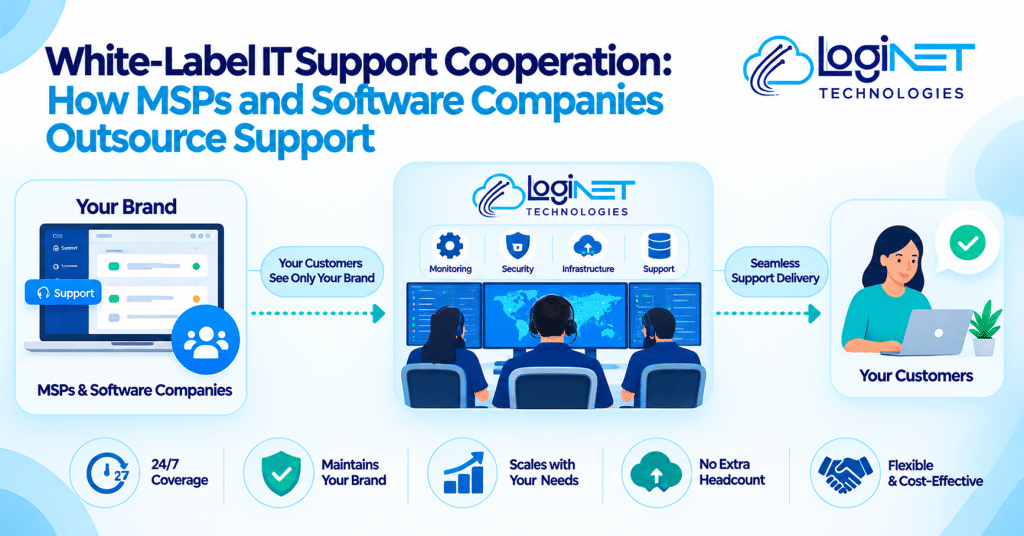
White-label IT support cooperation means your customers only ever see your brand on every ticket, email and call, while the technical delivery runs through Loginet in the background. For MSPs and software companies that have outgrown what their internal team can sustainably cover, this is a structure within broader IT outsourcing that lets support scale without your headcount or your branding changing at all.
Most companies evaluating this have hit an identical wall. Ticket volume is outpacing the team, customers expect coverage outside standard hours, and hiring enough engineers to match demand doesn’t stack up financially at current scale. White-labelling solves one specific problem: adding delivery capacity without adding headcount, and without a single customer-facing touchpoint revealing a third party is involved.
Why MSPs Specifically Look at This
An MSP selling IT support as its core offering bringing in external support sounds contradictory until you see where the actual gap sits. Most MSPs are strong in specific areas, Microsoft 365 administration or network security being common ones, and weaker elsewhere.
Rather than declining a client request outside that strength, or hiring specialists for skills only needed occasionally, white-label support closes that exact gap. The client still deals with the MSP they signed with. The MSP simply has backup capacity it doesn’t advertise. IT support for software companies and MSPs structured this way also absorbs overflow: a busy month, a product launch, an engineer who’s left and hasn’t been replaced yet. None of that needs to become visible to the end client.
Why Software Companies Approach This Differently
A software company’s situation is rarely about overflow. It’s that support was never meant to be a core competency in the first place. Engineers who built the product get pulled into resetting a customer’s password instead of shipping features, which is an expensive way to staff Tier 1 ticket volume.
White-label support lets a software company offer proper customer support under its own name without diverting product engineers into a role they’re overqualified for. The customer still emails support@yourcompany.com. They have no visibility into who’s actually answering it.
How White-Labelling Stays Genuinely Invisible: The Technical Mechanics
Staying invisible isn’t just a branding promise, it’s a technical setup that has to be configured correctly or the illusion breaks the first time a customer checks an email header.
Email authentication is the part most providers skip and most customers never notice until it fails. Notification emails sent on your behalf need SPF includes, DKIM signing, and DMARC alignment configured on your own domain, not a generic third-party sender address. Done properly, every email a customer receives authenticates as coming from your domain, passing deliverability checks cleanly with no third-party exposure visible in the headers.
Ticketing and tool synchronisation matters just as much. PSA and RMM platforms, tools like ConnectWise, Datto Autotask, HaloPSA or NinjaOne depending on what your stack already runs, need to federate through secure APIs so tickets sync bidirectionally. A ticket raised in your system should update in real time regardless of which side is actually working it.
Telephony is the layer customers notice fastest if it’s done badly. Masked call queues, a branded Interactive Voice Response menu, and custom call scripts running through a platform like 3CX or Microsoft Teams Voice all need configuring so a customer calling your support line hears your company name, your hold messaging, your branding, start to finish.
The Tier Framework: What L1, L2 and L3 Actually Cover
Multi-tier IT support (L1, L2, L3) only works with clearly defined scope at each level, otherwise tickets bounce between tiers instead of resolving.
Level 1 covers triage: password resets, basic connectivity issues, account access problems, and anything following a known, documented resolution path. High volume, fast turnaround, minimal technical depth required. Level 2 covers advanced operating system issues, network routing problems, and application-level bugs that need someone who actually understands the underlying system rather than a script. Level 3 is reserved for architecture-level flaws, code-level escalation, and complex infrastructure outages, the cases that need someone capable of reading the actual system design, not just the symptom.
Specific operational targets like First Response Time, First Contact Resolution rate, and Mean Time to Resolution genuinely matter here, but the actual numbers depend on ticket severity and what’s written into your specific service agreement, so a blanket figure isn’t something to publish as a universal promise. The structural principle holds regardless: fast acknowledgment on critical issues, documented and reasonable turnaround on everything else.
The Australian Commercial Reality Behind This Decision
Running a 24/7 internal support roster in Australia carries real cost beyond base salary. Shift loadings, weekend and public holiday penalty rates, and superannuation obligations under the relevant modern award all apply to after-hours coverage, and they add up fast once you’re rostering multiple people across a genuine round-the-clock schedule.
White-label partnerships remove that hiring friction entirely. You’re not recruiting, training and retaining a shift-based team to cover hours your core business doesn’t otherwise need staffed. This matters particularly for software companies and MSPs operating out of Queensland hubs, where the specialist technical labour pool for round-the-clock coverage is tighter than it is in the larger east coast capitals.
Data handling still needs to meet the Australian Privacy Principles regardless of who’s actually answering the ticket, so any arrangement worth entering should confirm upfront how customer data is stored, accessed and handled under that framework, not assume it’s covered by default.
Readiness Audit: When to Outsource Support vs Retaining In-House Teams
| Factor | Outsource (white-label fits) | Retain in-house |
|---|---|---|
| Ticket volume velocity | Growing faster than current headcount can absorb | Stable and comfortably handled by existing team |
| Engineering core focus | Developers being pulled into support tickets | Support already fully separated from product work |
| Coverage scope | After-hours or 24/7 expected by customers | Business hours only, low urgency outside that window |
| Brand control mechanics | Must remain entirely under your own identity | Open to a visible or co-branded third party |
| Technical skill breadth | Needs span beyond what the internal team specialises in | Fully covered by existing in-house capability |
Business IT support Queensland software companies and MSPs rely on tends to be structured flexibly rather than locking you into one fixed tier arrangement from day one. Most sensible starting points are overflow or after-hours coverage only, with fuller L1 through L3 support added once volume justifies it.
A Few Things People Actually Ask
Will our customers ever find out a third party is handling support?
Not if the technical setup is done properly. Email authentication, ticketing sync, and telephony all carry your branding end to end, with nothing in the customer-facing experience exposing a third party.
Can we start small and scale up later?
Yes. Most arrangements begin with overflow or after-hours coverage only, then expand into fuller L1 through L3 support once volume and trust are both established.
Do we lose control over how support is actually delivered?
No. Processes, tone, escalation rules and SLA targets are all defined by you upfront. The external team operates inside those guidelines rather than inventing its own approach.
If you want an honest scoping conversation about what white-label IT support would actually look like for your ticket volume, tooling and coverage needs, get in touch with Loginet Technologies for an operational review.