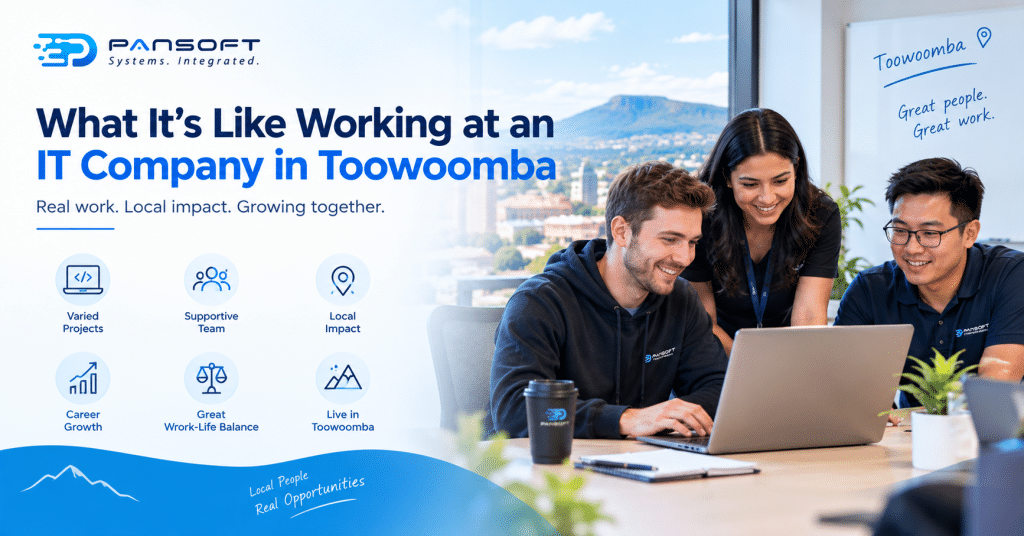
What It’s Like Working at an IT Company in Toowoomba
Some days it’s a quiet ticket queue and a coffee. Other days it’s three sites down at once and everyone’s on a call figuring out why. That’s the honest answer: the work varies more than a careers page usually admits, and the variety is part of why people stay.
This article walks through what the day-to-day actually looks like at an IT company in Toowoomba, who tends to do well here, and what to expect if you’re weighing up Loginet careers against a bigger city firm or a fully remote role. If you want the formal side, the careers page has current openings and how to apply.
A regional IT company, not a call centre
Toowoomba isn’t Brisbane, and that shapes the work. Clients are often local businesses you can drive to, not accounts managed through three layers of ticketing software. When something breaks for a manufacturer out past Wellcamp or a clinic in the CBD, there’s a decent chance you’ll meet the people affected, not just their help desk alias. That changes how the job feels. Problems have faces attached to them, and fixes have visible consequences.
It also means the team wears more hats than a specialist would at a capital-city enterprise. A support engineer here might touch networking one day and a cloud migration the next, rather than living inside one narrow lane for years. Some people find that unsettling at first. Most end up preferring it, because the learning curve never really flattens out.
What a normal week looks like
Mornings usually start with the queue: overnight alerts, anything that came in after hours, and whatever’s most urgent. From there it splits depending on your role. Support and helpdesk staff work through tickets, some quick, some genuinely tricky. Project and development staff are usually deeper into something longer-running, a migration, a build, an integration that’s been going for weeks.
Meetings exist, but they tend to be short and purposeful rather than calendar filler. Stand-ups, client check-ins, the odd planning session. Nobody’s pretending back-to-back meetings are productive.
What ties it together is that the work is rarely identical two days running. One reason people look at software developer jobs in Toowoomba specifically, rather than just any dev role, is that a smaller company means touching more of the stack. You’re not stuck maintaining one microservice forever. You might be in the database one morning and reviewing a colleague’s pull request that afternoon.
Who tends to do well here
Curiosity matters more than a long resume. The people who thrive are the ones who’ll say “I haven’t done this before, but let’s work it out” instead of waiting to be handed a script. Because the team is smaller than a capital-city firm’s IT department, everyone’s contribution is visible. That’s a plus for people who want to be known for their work, and a genuine adjustment for anyone used to disappearing into a large team.
Communication matters just as much as technical skill. A lot of the job is explaining something technical to someone who isn’t, whether that’s a client asking why their internet’s slow or a colleague asking for a second opinion on an approach. If you’d rather just write code and never talk to anyone, a bigger, more siloed organisation might suit you better than an IT company where careers stay broad.
Growth and pathways
Career growth in a smaller regional team doesn’t always follow a straight ladder, and that’s worth being upfront about. There’s less of a fixed hierarchy to climb, but more room to shape your own direction by picking up work that interests you and building depth there. Someone who starts on the helpdesk might move into projects, then specialise in security or cloud, depending on where their interest and the business’s needs meet. The team behind Loginet has generally grown people this way rather than only hiring specialists from outside, and the specifics of any training or certification support are worth asking about directly when you apply.
For people early in their career, that’s often the appeal of IT graduate careers in Queensland outside the capital: fewer people competing for the same handful of interesting projects, and a shorter distance between “I want to learn X” and actually getting to touch X.
Toowoomba and the wider Darling Downs
Being based in Toowoomba puts the team close to a wider Darling Downs region, agriculture, logistics, manufacturing, and healthcare businesses, each with genuinely different IT needs. That mix keeps the work varied in a way that’s harder to get if every client runs the same stack. Tech jobs in the Darling Downs also tend to mean a shorter commute and a lower cost of living than the same role in a capital city, without necessarily meaning less interesting work.
What about remote work?
This is worth answering honestly rather than glossing over. Not every regional IT role offers full remote flexibility, and client-facing or on-site support work is naturally harder to do from home than a purely development-focused role. Anyone comparing options against fully remote IT jobs in Australia should ask directly what’s possible for the specific role they’re applying for, because it genuinely varies by position and by how client-facing the work is.
Questions worth asking
Do I need previous MSP experience to apply?
Not necessarily. Some roles benefit from prior experience with MSP career pathways, understanding how ticketing, SLAs and client relationships work together, but plenty of people learn that structure on the job. What matters more is a genuine interest in solving problems for real clients.
Is it possible to specialise, or is everyone expected to be a generalist?
Both exist. Early on, especially in support roles, you’ll likely see a broad mix of work. Over time, most people find an area they gravitate towards, whether that’s security, cloud, or development, and the team supports that specialisation once it’s clear where someone’s interest lies.
What’s the biggest difference from working at a large capital-city IT firm?
Visibility and variety. Your work is seen and felt more directly, by clients and by the team, and you’re less likely to spend years on one narrow slice of a much bigger system.
Where to go from here
So in short: working at an IT company in Toowoomba means broader work, closer relationships with the people affected by what you build or fix, and more room to shape your own direction than a bigger, more siloed employer usually offers. What matters most to you in a role, variety, growth, or knowing your work is actually seen?
If that sounds like the kind of place you’d want to work, have a look at current openings or get in touch to ask a question first. No pressure, just a straightforward conversation.