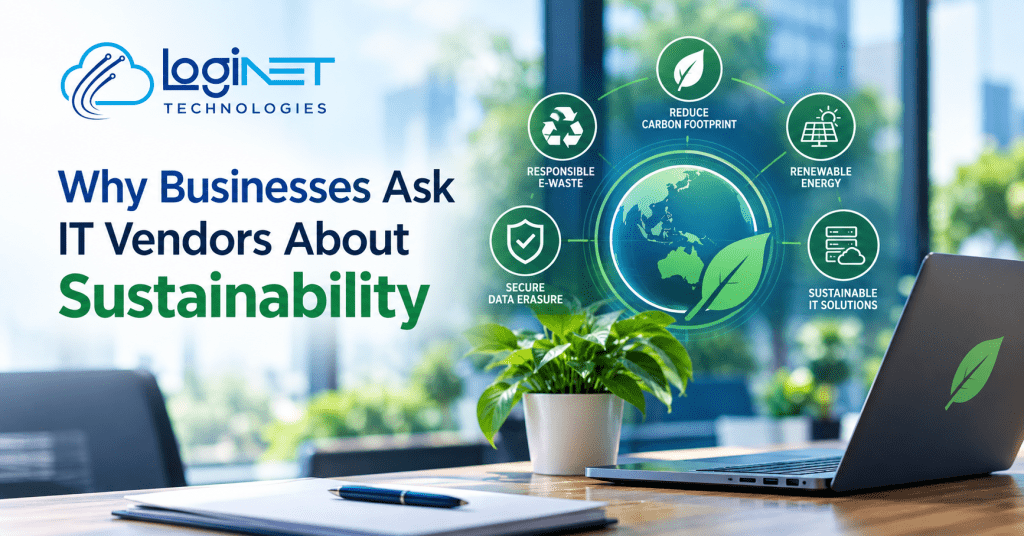
Why Businesses Ask IT Vendors About Sustainability
Because larger businesses now have to explain their environmental impact, and that includes the suppliers they buy from. Your IT vendor is part of that story. Sustainability has moved from a marketing line to a question in the tender, and vendors without a clear answer get harder to choose.
This article explains why businesses ask IT vendors about sustainability, what they’re really checking, and what a credible answer sounds like. If you’d like to see where Loginet stands first, our sustainability policy is on the website.
What changed: your customers now have to look at their suppliers
For years, sustainability sat with marketing. A paragraph on the website, maybe a page in the annual report. What changed is that new climate-related reporting rules started in Australia on 1 January 2025, and they’re being phased in across more businesses over the following years. Companies in scope have to disclose material climate-related risks and opportunities, including ones sitting in their value chain. Your vendor’s world, in other words.
In practice, large customers start putting questions to their suppliers. ASIC’s guidance for small business says a business with a large customer or supplier may be asked for information to help that customer meet its own obligations. It also says large businesses are expected to lean on estimates and industry averages in many cases rather than chase every supplier for data, and that you can speak to them directly if a request is hard to answer. So it isn’t a wall of paperwork. It’s a real question, though, and it’s turning up in tenders and renewals.
The term you’ll hear for this is vendor sustainability compliance: does a supplier meet the environmental expectations the buyer now has to answer for? It sits alongside the other compliance and governance questions a business already deals with.
Why IT vendors get asked first
IT is easy to point at. It’s physical, with laptops, servers and phones. It uses electricity all day. And eventually it becomes waste, which is why an e-waste and device recycling policy is often one of the first things a careful buyer looks for. It’s concrete, and you can check it.
There’s a second reason. Old equipment holds data, so how it’s retired matters twice: once for the environment, once for security. Buyers working through sustainable technology procurement often start with the IT supplier for exactly this reason, and they want green IT practices in Australia that a provider can describe plainly rather than promise vaguely.
What buyers actually check
| They ask | Why it matters | What a solid answer sounds like |
|---|---|---|
| Do you have a written policy? | Shows the topic is owned, not improvised | Specific commitments, a named owner, a review date |
| What happens to old equipment? | Devices become waste and hold data | A defined process covering reuse, recycling and secure data erasure |
| Can you supply information on request? | Buyers may need supplier data for their own reports | A clear contact, and honesty about what you can and can’t measure |
| Who is accountable? | Policies without owners tend to fade | A named role, not “the team” |
| How does it change day-to-day decisions? | Separates practice from marketing | An example of a choice the policy actually changed |
Sustainability, CSR and ESG: what’s the difference?
People use these terms as if they’re interchangeable, and they aren’t. A corporate sustainability policy focuses on environmental impact: energy, waste and resources. A corporate social responsibility policy is wider, covering ethics, community and how people are treated. An ESG policy is the version investors and lenders like, because it frames the same ground as environmental, social and governance factors they can weigh up side by side.
Each has its place. A good vendor can tell you which one their answer belongs to. If the document blurs all three into one glossy page, that’s your first clue.
Telling a real policy from a marketing one
Vague wording is the giveaway. “Committed to a greener future” tells you nothing. A real policy names things: which equipment, what happens at end of life, who is responsible, and when it gets reviewed. It should also be honest about limits. A vendor who says “we can’t measure that yet, here’s what we can do” is more believable than one claiming to have it all sorted.
Some buyers go further and ask for IT vendor ESG reporting, meaning regular, factual updates rather than a one-off statement. Smaller providers may not produce full reports, and that’s fine as long as they’re straight about it. How equipment is bought in the first place matters too, from choosing durable devices to sensible refresh cycles, so it’s worth raising with whoever handles your hardware procurement.
If a customer asks you first
Sometimes the question runs the other way: a larger customer asks your business for sustainability information. Don’t panic, and don’t invent numbers. Say what you know, be clear about what you’d have to estimate, and ask what they actually need. The rules themselves allow for information that’s too hard or costly to obtain, so an honest partial answer beats a confident guess. Your IT provider can often help with the equipment side of it, such as what you own and how it gets disposed of.
Questions worth asking
Does my business have to report on sustainability?
Not directly, for most small and mid-sized businesses. Sole traders, partnerships and trusts aren’t covered, and companies only come in once they pass size thresholds that phase in over several years. Larger customers may still ask you for information, so check with your accountant and be ready.
Is a sustainability policy enough on its own?
No. A policy is a starting point, not proof. Look for specifics: what’s committed, who owns it, how it’s measured and when it’s reviewed. A vendor who can explain how the policy changes everyday decisions is more credible than one with a polished PDF.
What should I ask my IT provider first?
Start with three plain questions. Is there a written policy? What happens to our old equipment? And can you help if one of our customers asks us for information? The answers quickly show whether sustainability is a working practice or a line on a website.
Where to go from here
So, in short: sustainability is now a supply chain question, and IT is one of the first places buyers look. What’s the first sustainability question a customer has put to your business? Tell us in the comments.
If you’d like to know where Loginet stands, read our position on sustainability or find out more about the company. And if you’d rather talk it through, get in touch whenever it suits. No pressure. Just a straightforward chat.