Co-Managed IT Services: Signs Your Internal IT Person Needs Backup
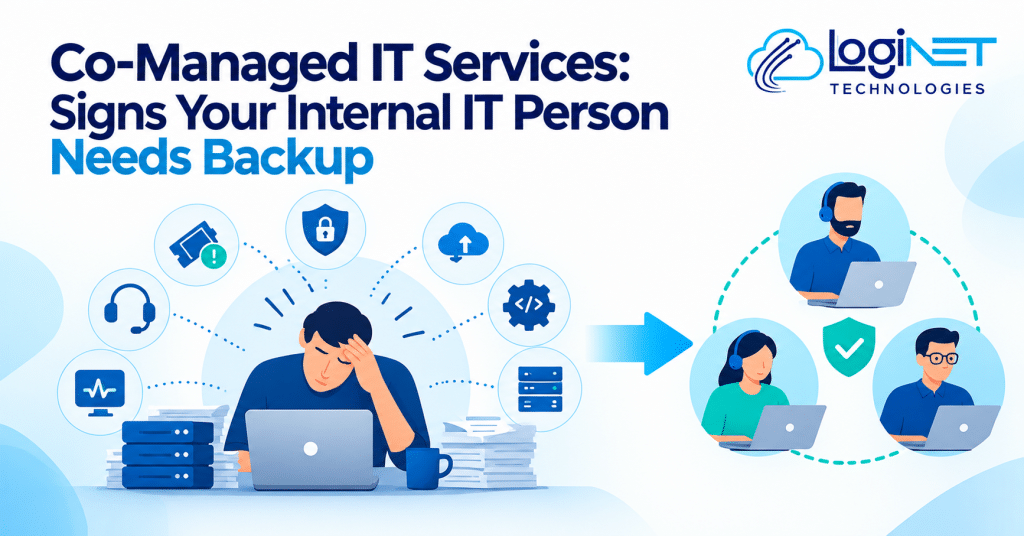
One person can’t be the network admin, the helpdesk, the security officer and the project manager, all at once. Not for long. If your internal IT person’s covering all of that, co-managed IT services close the gaps without taking their job away. A few signs make it obvious when that’s needed.
Nobody plans for this moment, really. One capable hire, things tick along fine for a year or two, then the business grows and the workload grows faster than the headcount did. Nobody decided the role should cover five jobs. It just ended up that way.
The backlog won’t shrink
Tickets pile up. Not laziness, just maths. More requests coming in than one person can clear. A twenty-minute fix sits for three days. Security patches get queued “for later,” and later doesn’t arrive.
Classic sign a shared IT support model would help here. Not a replacement. Backup for internal IT person coverage on the repetitive stuff, freeing them up for the things that actually need their specific knowledge of your systems.
They’re the only one who knows how anything works
Simple test. Two weeks off, unplanned, tomorrow. Does the business cope? For a lot of smaller businesses, no. One person holds the passwords, the vendor contacts, every quirk nobody else has bothered learning.
Not a knock on them. It’s just risky, structurally. A co-managed helpdesk Australia businesses can call on means a second set of hands already knows your setup. Nobody starting from scratch at 2am when something breaks.
Security gets handled after the fact
Patches go on when someone remembers to. Monitoring means glancing at a dashboard once a week, maybe. Nobody’s hunting the quiet stuff, the odd login attempt, the traffic pattern that doesn’t set off alarms but probably should.
Your IT person’s not ignoring this on purpose. There just aren’t enough hours. Security competes with fifty other tasks and loses, every time, until something actually breaks.
Projects stall out and stay stalled
The server migration’s been “in progress” four months running. The network upgrade keeps sliding another quarter. Plan’s fine. Reality keeps winning, because someone’s printer connection beats strategic work, daily, without fail.
This is exactly where an MSP for internal IT teams earns its keep. Absorbing the daily noise so your person can finally close out the project that’s sat half-done since winter.
Burnout, plain and simple
Late nights, most nights. Weekend calls. Slack messages answered at 11pm because there’s nobody else. Sound familiar? Not sustainable. Not fair to expect one person to carry that indefinitely either.
Bringing in internal IT overflow support isn’t a verdict on their ability. It means the job outgrew the headcount. Happens to good people in growing businesses, constantly.
What co-managed IT actually looks like
Here’s the useful part. Co-managed IT services don’t mean handing over the keys. Your person stays, keeps their knowledge of the business, keeps making the calls only someone on the inside should make. The external team covers overflow, after-hours monitoring, specialist skills one person was never going to have across every area, plus the grunt work eating their week.
| Signal | What it looks like | What co-managed support adds |
|---|---|---|
| Ticket backlog | Requests sit for days | Extra hands clearing routine tickets |
| Single point of failure | One person knows everything | A second team, documented access |
| Reactive security | Late patches, no active monitoring | 24/7 monitoring, proactive patching |
| Stalled projects | Upgrades keep slipping | Dedicated capacity for project work |
| Burnout | After-hours calls, no real downtime | Shared on-call coverage |
It’s a hybrid IT support model, not a takeover. Think of it as a way to extend internal IT team capacity, minus the cost and delay of hiring a second or third full-timer. That math often doesn’t work until a business is a fair bit bigger than yours might be right now.
Need less “more hands” and more “someone thinking three years out” instead? That’s a slightly different conversation, closer to what a virtual CIO role covers. Some businesses need both, working together. Others just need the operational backup first, strategy later.
Worth knowing too, co-managed support and fully managed IT services aren’t the same thing. Managed services usually mean an outside provider runs IT end to end. Co-managed keeps your person in the driver’s seat and brings in support around them, specifically.
A few questions people actually ask
Will co-managed support make our IT person feel replaced?
Shouldn’t, if it’s set up right. The aim is pulling off the parts grinding them down, not the parts where their knowledge of the business actually matters.
How do we know if we need co-managed support or just another hire?
Comes down to how steady the extra workload is. Overflow and after-hours coverage, co-managed usually costs less and starts faster than recruiting someone new.
Does this still make sense if our IT person’s genuinely good?
Yes, honestly, that’s often when it works best. Not fixing a skills gap. Giving a capable person enough hours to actually use the skills they’ve got.
If any of this sounds familiar, get in touch with Loginet Technologies and we’ll talk through what co-managed IT could look like for your setup.