IT Company Toowoomba Queensland vs Gold Coast: Does Location Still Matter for Managed IT Support?
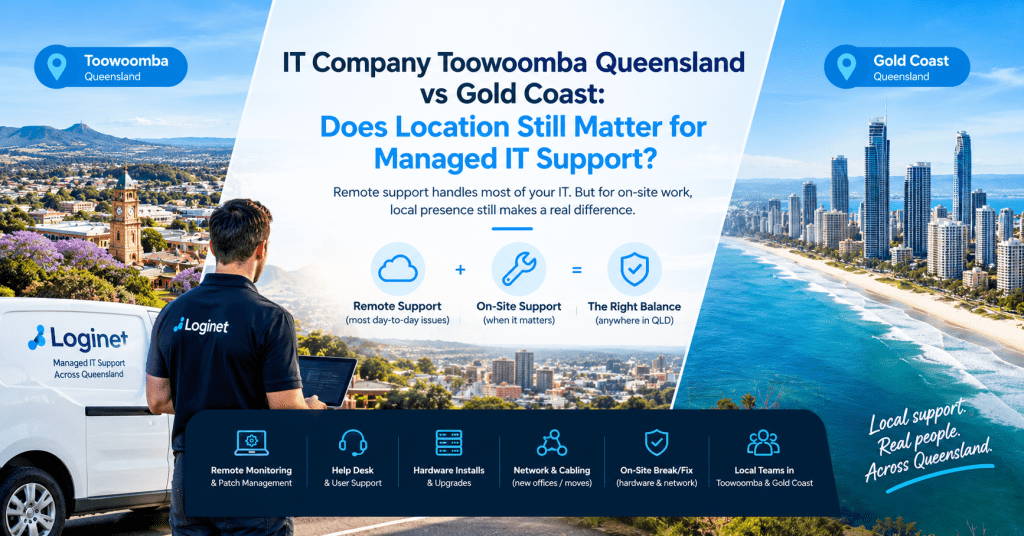
Location still matters, just not in the way it used to. Most day-to-day IT support, monitoring, patching, help desk tickets, doesn’t care where your provider’s office is, because it’s all handled remotely regardless. What still depends on a physical location is anything that needs hands on a keyboard or a cable, a new server going in, a hardware failure, an office move, and that’s the part worth checking before you assume “remote-first” means “location doesn’t matter at all.”
Here’s how that actually plays out for businesses choosing between providers based in different parts of Queensland.
What Actually Changed Once IT Support Went Remote
A decade ago, having your IT provider based nearby was close to essential. Most fixes needed someone physically at your desk, and a provider three hours away simply couldn’t respond fast enough for routine issues. Remote monitoring and remote access tools changed that almost completely. A technician sitting anywhere can now watch your network, push updates, and resolve the vast majority of tickets without ever getting in a car.
That shift is genuinely good news for businesses, because it means the pool of providers worth considering isn’t limited to whoever happens to have an office in your suburb. But it also means “location doesn’t matter anymore” gets repeated as a blanket statement more often than it should, because a meaningful slice of IT work still can’t be done from a laptop two hundred kilometres away.
Where Local Still Genuinely Matters
The honest list of situations where being close by makes a real difference is shorter than it used to be, but it’s not empty. New hardware installs, a server refresh, network switches, cabling for a new office fit-out, still need a person physically present. So does diagnosing anything involving a genuinely broken physical component, a failed hard drive, a dead access point, a router that won’t reboot cleanly.
There’s also a category of situations that are technically solvable remotely but go faster and with less friction in person: onboarding a large batch of new staff at once, an office relocation, or a compliance audit where someone wants to physically walk the site and check what’s actually plugged in versus what’s documented. None of these happen every week, but when they do happen, the difference between a provider who can be on-site same-day and one coordinating a flight or a long drive is real.
Toowoomba as a Business Hub in Its Own Right, Not Just “Regional”
It’s worth being specific here rather than lumping every non-metro location together as “regional and therefore secondary.” Toowoomba’s own development reporting describes it as Queensland’s largest inland city, with a genuinely diverse economy spanning agriculture, health, education, manufacturing and a growing logistics sector anchored by Wellcamp Airport and the Inland Rail project. That’s not a small satellite town, it’s a significant regional economy with its own scale of business activity, which is exactly why a proper IT company Toowoomba QLD businesses can actually visit matters rather than being an afterthought bolted onto a Brisbane or Gold Coast operation.
For businesses actually based in the Toowoomba region, working with IT services Toowoomba providers who understand the local business landscape, agribusiness compliance quirks, healthcare and education-sector obligations, the practical realities of connectivity outside a capital city CBD, tends to mean fewer wasted conversations explaining context a metro-based provider would need spelled out from scratch.
What This Looks Like for Gold Coast Businesses
The same logic runs the other way for businesses on the coast. IT services Gold Coast clients need a provider who understands a different mix, tourism and hospitality seasonality, a denser small-business retail environment, and a workforce that skews toward hybrid and remote arrangements more than some inland industries do. An IT company Bundall QLD presence specifically matters for exactly the same reasons Toowoomba presence matters locally: same-day hands-on support when something physical breaks, and a team who already understands the area rather than treating it as a satellite job.
The practical takeaway either way is the same. Remote-first support means your provider doesn’t need to be down the road for the majority of what they do. It does mean you should ask directly whether they have genuine local presence, not a call centre with a Queensland phone number, for the situations where physical presence actually matters.
How to Actually Evaluate a Provider on This
A few direct questions cut through most of the ambiguity. If something physically breaks tomorrow, who actually comes out, and how fast? Is your team local to the region, or is on-site work subcontracted to a third party you’d be meeting for the first time during an actual incident? And for businesses running multiple sites, can the same provider genuinely cover both locations properly, or does one office get better service than the other by default?
A provider covering more than one region, the way Loginet operates across both Toowoomba and Bundall/Gold Coast, is worth asking about specifically here, since it’s one way to get consistent managed IT support without the coverage quality dropping off depending on which office happens to be closer.
Frequently Asked Questions
If most support is remote, why does Loginet maintain offices in two locations rather than one?
Because the situations that need a person physically present don’t disappear just because most tickets can be handled remotely, and covering two regions properly means genuine local response in both, not one office serving as the “real” location while the other is a satellite.
Is remote-only IT support ever a red flag?
Not automatically, plenty of remote-first providers do excellent work. It’s worth asking specifically what happens when something needs hands-on attention, rather than assuming that scenario is covered just because the provider is competent remotely.
Does a local provider cost more than a purely remote one?
If you’re weighing up providers and want a straight answer on what genuine local coverage would actually look like for your locations, get in touch with Loginet and we’re happy to talk it through.