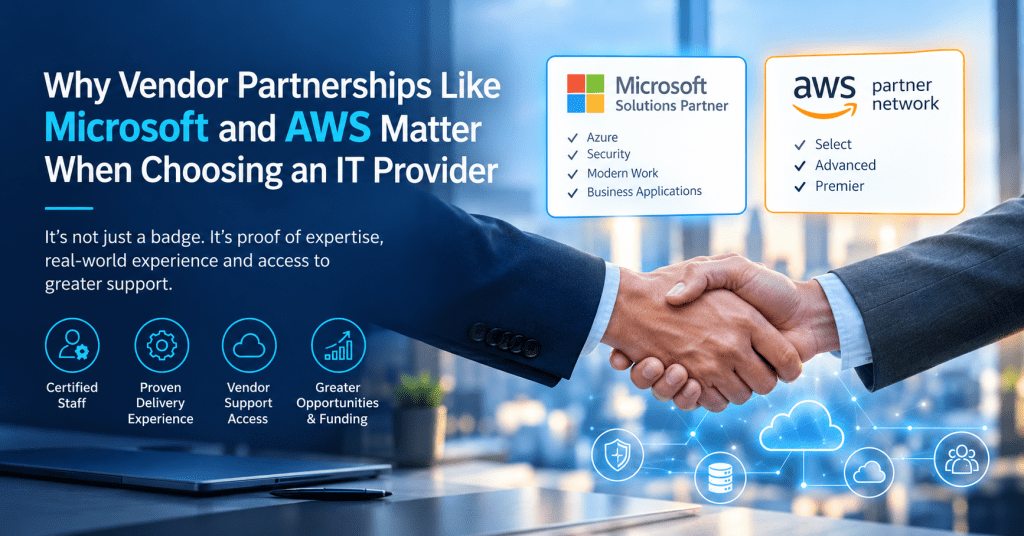
Why Vendor Partnerships Like Microsoft and AWS Matter When Choosing an IT Provider
If a provider tells you they’re “a Microsoft partner” or “an AWS partner,” that phrase alone tells you almost nothing. Partner status comes in tiers, and the difference between the bottom tier and the top one is enormous, in certified staff, in proven delivery experience, and in what the vendor itself is willing to vouch for. Before you sign with an IT provider, it’s worth asking exactly which tier they hold and in which areas, because that answer says more about their actual capability than most of what’s in a glossy proposal.
Here’s why that distinction is worth chasing down properly.
What a Vendor Partnership Actually Certifies
A vendor partnership isn’t a badge a company slaps on their website after filling out a form. Both Microsoft and AWS run structured programs that measure a provider against real, checkable criteria, and neither one is quick to earn.
Take an IT provider claiming Microsoft partner Australia status through a Solutions Partner designation. Microsoft retired the old Gold and Silver Partner tiers back in 2022 and replaced them with a scoring system built around three categories, performance, skilling, and customer success, each worth points toward a minimum threshold of 70. Performance is measured by net new customers using the relevant Microsoft technology. Skilling is measured by how many staff hold the specific certifications tied to that solution area, whether that’s security, modern work, or Azure infrastructure. Customer success is measured by actual usage growth and successful deployments, not testimonials. It’s re-evaluated continuously, not awarded once and forgotten.
AWS runs something similar but structures it as a tier ladder rather than solution-specific designations. Providers holding AWS partner Australia status sit somewhere on a scale of Select, Advanced, or Premier, and the jump between tiers is steep. A Select tier partner needs a handful of certified staff and a small number of completed customer projects. Premier tier, by contrast, requires twenty accredited staff, at least ten of them holding professional or specialty-level certifications, fifty launched customer engagements generating real recurring revenue, and a sustained track record of meeting all of that for over six months straight. AWS doesn’t hand that out for showing up.
The point of both systems is the same: they’re proof, verified by the vendor itself, that a provider’s staff actually know the platform and have delivered real outcomes on it, not just attended a training course once.
Why This Matters More Than a Company’s Own Claims
Anyone can write “expert in cloud solutions” on a homepage. What they can’t do is fake a Microsoft or AWS partner tier, because the vendor is the one awarding it, and the vendor has no reason to inflate someone else’s credentials. That’s what makes it a genuinely useful filter when you’re comparing providers, rather than just another line item competing for your attention on a proposal.
It also tells you something about depth. A provider holding a Microsoft Solutions Partner designation for Security has demonstrably different capability to one who’s simply “familiar with” Microsoft 365. The same goes on the AWS side, an Advanced or Premier tier partner has been through enough engagements that the vendor itself is confident enough to say so publicly, with numbers attached.
None of this means a lower-tier or newer partner is automatically the wrong choice, some do excellent work and are simply earlier in the process of building up certified staff and completed projects. But if a provider is charging premium rates and leaning heavily on vendor relationships as a selling point, it’s fair to expect the tier to match the pitch.
What to Actually Ask a Provider
A few direct questions tend to cut through the marketing quickly. Which specific Microsoft designation or AWS tier do you hold, and in which solution area? How many of your staff carry the certifications tied to that designation, not just general product familiarity? Can you name a recent project in that specific area, without needing to invent details on the spot?
It’s also worth asking whether the partnership covers what you actually need. A provider might hold a strong ServiceNow partner Australia credential and be genuinely excellent at ITSM platform work, while having comparatively little depth on the AWS side. That’s not a red flag by itself, it’s a reason to match the partnership to the specific work you’re hiring them for, rather than assuming one badge covers everything.
If a provider gets vague or defensive when asked to name the specific tier or designation, that’s worth noting. A provider confident in their standing will usually tell you exactly where they sit and what it took to get there.
Why This Isn’t Just a Box-Ticking Exercise
The deeper reason vendor partnerships matter comes down to access. Higher-tier IT partners Australia providers typically get earlier access to new features, direct escalation paths into vendor support when something goes seriously wrong, and funding programs that can genuinely offset the cost of a migration or proof-of-concept project. A Select tier AWS partner and a Premier tier one aren’t just different in prestige, they have access to different tools for solving your problem when it gets complicated.
This is also where the underlying platform work connects back to a broader relationship. Vendor partnerships aren’t collected for their own sake, they exist because a provider is doing consistent, hands-on work in that platform, which is usually the same work that shows up in ongoing cloud management and support.
A Few Questions Worth Asking Yourself
Does a higher partner tier always mean a better fit for my business?
Not automatically. Tier reflects scale and proven delivery volume more than it reflects fit for your specific situation. A smaller, lower-tier partner with direct experience in your industry can still be the right call, but it’s worth knowing the tier either way so you’re choosing with full information rather than assuming.
Should I be worried if a provider only holds one vendor partnership, not both Microsoft and AWS?
Not necessarily. Plenty of solid providers specialise rather than spreading across every platform. What matters more is whether their partnership aligns with the platform your business actually runs on.
How often do these partner tiers actually get checked or renewed?
Both Microsoft and AWS re-verify on an ongoing basis rather than issuing a one-off certificate, Microsoft’s model recalculates continuously, and AWS requires sustained performance over time to maintain the higher tiers. A tier mentioned on a website from two years ago is worth confirming is still current.
If you’d like a second opinion on a provider’s partner credentials, or want to know exactly where Loginet sits on the Microsoft and AWS partner ladders, get in touch and we’re happy to walk through it plainly.