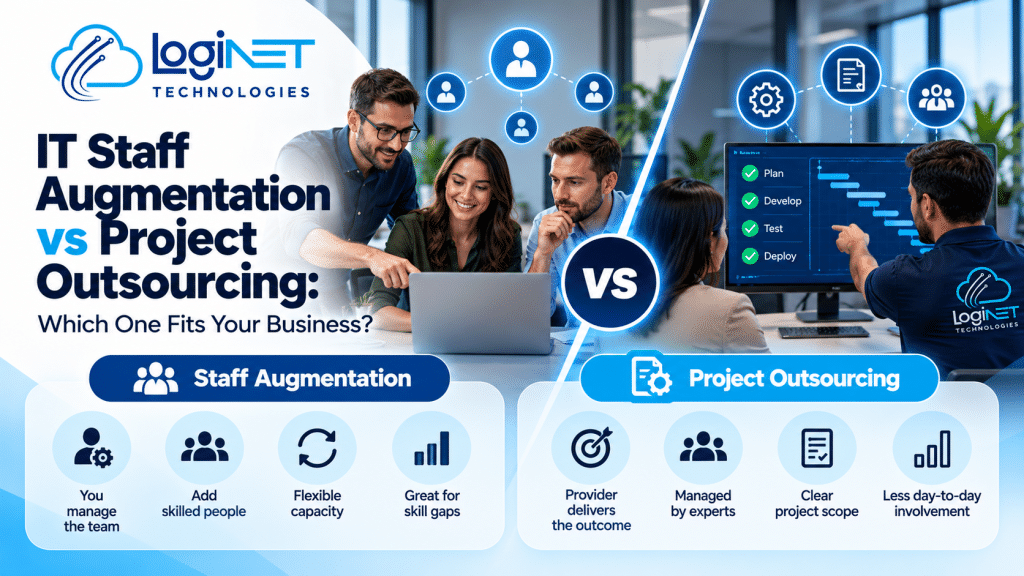
IT Staff Augmentation vs Project Outsourcing: Which One Fits Your Business?
Staff augmentation adds skilled people to your team, and you manage them. Project outsourcing hands the result and the delivery to an outside team. Pick based on how much control you want and how much management time you actually have spare.
The IT staff augmentation vs project outsourcing question usually lands on someone’s desk when a deadline is already close. A migration’s stalled, or the software build needs skills nobody in the office has. Both options work. Picking the wrong one is what causes the headaches.
Who manages the work in each model?
With staff augmentation, you do. The specialists take direction from your people. With outsourcing, the provider runs the team and answers for delivery, so you set the goal and check the results.
Real projects blur that line, so Loginet works in four set-ups. Staff augmentation, where the specialists are managed directly by you. A self-managed team led by a project manager or team lead from our side. Full outsourcing, where we’re responsible for delivery. And co-sourcing, where our people work alongside your team or your existing vendors.
The catch most owners miss: if nobody on your side has time to direct the work, augmentation gets slow and frustrating, no matter how good the specialist is.
When does adding people to your own team make more sense?
When you already have someone who can direct the work, and what you’re missing is skills or capacity. A gap in cloud or security skills, or a deadline your team can’t hit alone, fits well.
Think of it as renting skills while you stay in charge. We offer it in a few shapes:
- Project-based resources for a fixed-term job, like a cloud migration or a software build.
- Short-term expertise for niche skills, urgent upgrades, compliance work or a busy patch.
- Dedicated team extension, where specialists work as part of your team with our technical leadership backing them up. Great for ongoing work, as long as someone on your side has the hours to steer.
- Long-term strategic support, so the knowledge stays put instead of walking out the door.
The skills on offer span cloud and DevOps, software development, cybersecurity, infrastructure and networking, business analysis and project management, and data and AI. If you want the detail, see how our IT staff augmentation works.
People are chosen on technical expertise, industry experience and cultural alignment. Don’t skip that last one. A brilliant engineer who clashes with your team can drag everyone down. The process itself is simple: we work out what you need, source the right people, onboard them, keep supporting them, and scale up or down as the work changes.
When does handing over a whole project make more sense?
When the outcome is clear but you don’t have the people, time or appetite to manage the work. You care about what gets delivered, not about who sits in which seat.
Picture a business that needs a customer portal built. The owner knows what it should do. Nobody on staff has built one, and nobody has the hours to run a dev team. That’s outsourcing territory, and our IT outsourcing service is built for it.
There’s a middle option too. If you’ve got an IT person you want driving, but you need extra hands working next to them, that’s the shared set-up from the list above. It’s spot on for businesses that don’t want to hand over the whole job.
How do the two compare side by side?
They differ mainly on control, who manages the people, and how you pay. Staff augmentation gives you more control and more management work, while outsourcing trades some control for less day-to-day involvement.
Laid out plainly, staff augmentation vs outsourcing looks like this:
| Staff augmentation | Project outsourcing | |
|---|---|---|
| Control | High. You set tasks and priorities daily | Medium. You set the goal and review results |
| Who manages the team | You or your team lead | The provider’s project manager or team lead |
| Best suited for | Skill gaps, extra capacity, short bursts | Defined projects, or a whole function handed over |
| How pricing usually works | Based on the time you use the people | Fixed price, or time-based with a cap, depending on scope |
| Flexibility | High. Redirect people as priorities change | Lower once scope is fixed |
| Typical risks | Your team becomes the bottleneck | Vague scope, so the result misses the brief |
How does the pricing differ between the two?
Staff augmentation is usually priced on the time you use the people. Outsourcing is priced on the work, either fixed or on time with a cap, depending on how clear the scope is.
On the outsourcing side, we use fixed price for smaller projects and proofs of concept. Time and materials with a cap suits advisory work and projects that need to flex. Support is different again: per-ticket pricing for L1 and L2 issues, and a fixed monthly fee for ongoing L3 support and maintenance.
Before anyone commits, we run an assessment that puts your in-house cost next to the outsourced cost. It’s basically checking the numbers before signing, and it’s easy to skip when a deadline’s breathing down your neck.
What happens when the scope changes halfway through?
With augmentation, you just redirect the people, since you’re running the work. With outsourcing, a fixed scope needs a change conversation, which is why shifting work suits a capped time-based arrangement better.
Scope changes are where most of the arguments start, to be frank. Write down what “done” looks like before work begins, and agree how changes get handled. Augmentation also flexes in size, so you can add or release people as the work grows or winds down.
When is neither the right answer?
When the real problem is a missing process, an unclear goal, or a role that should be a permanent hire. Extra hands or an outside team won’t fix any of those.
Run a quick gut-check before you pick a model:
- Can you describe what finished looks like?
- Does someone on your side have real hours to direct the work, or will it fall on whoever’s already flat out?
- Will you still need this skill in 12 months? If yes, think about hiring.
We’ve worked in IT for 4+ years, and every project is senior-led. If your answers point somewhere else entirely, that’s worth knowing before you spend a dollar.
FAQs
Which is cheaper, staff augmentation or project outsourcing?
Neither is cheaper across the board. Augmentation tends to cost less when you need a few skills for a short time and can manage them yourself. Outsourcing tends to win when managing a team would eat your own hours, so compare the full cost, including your time.
Can a business start with one and move to the other?
Yes, and it’s a sensible way to test the working relationship. Start with a short-term specialist, then move to a larger team or a handed-over project once you know what you actually need.
How long can an engagement run?
From 1 month to 4+ years. Short engagements suit a fixed job like a migration, while longer ones suit continuity, so knowledge doesn’t walk out the door.
Who is responsible if the work goes wrong?
Under staff augmentation, you direct the work, so you carry most of the delivery responsibility. Under full outsourcing, the provider is responsible for delivery quality and performance.
Not sure which one fits? Talk it through with Loginet on (07) 4599 7909 or at contact@loginet.com.au. No pressure, just a straight conversation.