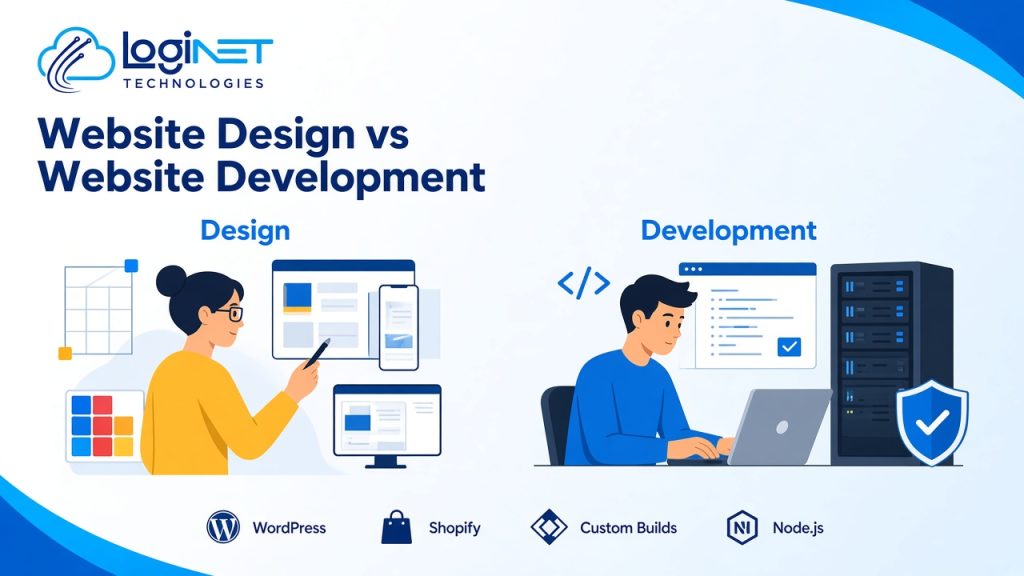
Short answer: Website design is about how a site looks and how people use it: layout, branding, content structure and user experience. Website development is about how it works: the code, the content management system, integrations, hosting, speed and security. A good business website needs both. Most quotes bundle them, so it helps to know which part of the price covers which job.
When business owners in Toowoomba, on the Gold Coast and in Brisbane ask us for “a new website”, they often mean different things. Some need a visual refresh. Others need a site that takes bookings, connects to their CRM or runs a customer portal. Knowing the difference between design and development helps you write a clearer brief, compare quotes fairly and avoid paying for the wrong thing.
What does website design cover?
Website design is the planning and visual side of a site. It usually includes:
- Information architecture: which pages you need, how they are grouped and how visitors move between them
- Wireframes: simple page layouts that show where content, calls to action and forms sit
- Visual design: colours, typography, imagery and how your brand appears on screen
- User experience (UX): making it easy for visitors to find what they need and take the next step
- Responsive layouts: how each page adapts to phones, tablets and desktops
- Accessibility basics: colour contrast, readable fonts and clear structure, so more people can use the site
The result of design is a set of approved layouts or a clickable prototype. It shows what the site will be like, but it doesn’t run on its own.
What does website development cover?
Website development turns the design into a working site and keeps it running. It usually includes:
- Front-end development: building the pages people see in HTML, CSS and JavaScript, so they match the design and work in every major browser
- Back-end development: the server-side code, database and logic behind forms, logins, bookings or online payments
- Content management system (CMS): setting up a platform such as WordPress, so your team can update pages without a developer
- Integrations: connecting the site to tools such as your CRM, email marketing, booking system or accounting software
- Performance: fast-loading pages, optimised images and caching
- Security: updates, secure hosting, backups, SSL and protection for forms and logins
- Technical SEO: clean URLs, structured data, sitemaps and page speed, so search engines can crawl and understand the site
- Testing and launch: checking functions, forms and devices before going live, then setting up redirects from any old URLs
Our website development team builds the front end and back end in-house. We build websites with WordPress (including the Astra theme), Shopify, custom builds and popular technologies such as Node.js, with skills across front-end frameworks, PHP and JavaScript.
How do design and development work together?
On a well-run project, the two run in sequence and overlap:
- Discovery: goals, audience, content and functions are agreed.
- Design: sitemap, wireframes and visual design are produced and approved.
- Development: the approved design is built, content is loaded and integrations are connected.
- Testing: designers check the build matches the design, and developers fix bugs and performance issues.
- Launch and support: the site goes live, then gets ongoing updates, security patches and improvements.
Problems usually start when the steps are separated. A design created without input from a developer can include features that are slow or expensive to build. A build without a proper design can work technically but fail to turn visitors into enquiries.
Do you need a designer, a developer or both?
It depends on what you are changing.
| Situation | Mostly design | Mostly development | Both |
|---|---|---|---|
| Rebrand with a new logo and colours | ✓ | ||
| Site looks fine but is slow or keeps breaking | ✓ | ||
| Adding online bookings, payments or a portal | ✓ | ||
| Moving from an old platform to a new CMS | ✓ | ||
| Launching a new business or service line | ✓ | ||
| Low enquiries despite steady traffic | ✓ (UX and calls to action) | Often |
If you are not sure, start with the problem you want to solve, such as more enquiries, less admin or a faster site. A good partner will tell you which skills the job needs.
What are you paying for in a website quote?
Quotes vary widely because they cover different amounts of design and development work. When comparing them, look for:
- Number of unique page templates, not just the number of pages
- Custom design or a pre-made theme: a theme is quicker, while custom design fits your brand and goals more closely
- Functions and integrations: forms, bookings, e-commerce, logins and API connections take the most development time
- Content: whether copywriting, photography and content loading are included
- SEO and redirects: especially important when you replace an existing site
- Hosting, security and maintenance: whether ongoing support is part of the price or extra
- Ownership: who owns the design files, code, domain and hosting accounts
We don’t publish set prices, because the scope of each website is different. A short discovery session is the fastest way to get an accurate quote.
What should you ask before you sign?
- Who will do the design, and who will do the development? Are they in-house or subcontracted?
- Which CMS or platform will you use, and why does it suit us?
- Can our team edit content without a developer?
- How do you handle security updates and backups after launch?
- What happens to our search rankings when the old site is replaced?
- Do we own the site, code and accounts when the project ends?
- What does ongoing support include?
Why choose Loginet for website development?
Loginet has been delivering IT services for more than four years. Our in-house development team builds websites and web applications. They work with our wider team of 20+ IT experts, so hosting, email, Microsoft 365 and security are looked after together, not left to separate suppliers. When a project needs extra capacity, we can draw on a pool of 50+ IT resources worldwide.
Because we also run IT and cybersecurity services, we think about the parts of a website that are often forgotten: secure hosting, backups, access control and what happens when a plugin needs updating.
Frequently asked questions
Is web design the same as web development?
No. Design covers how the site looks and how people use it. Development covers the code, CMS, integrations, hosting and security that make it work.
Can one company do both website design and development?
Yes. Many projects go more smoothly when one team handles both, because the design is planned with the build in mind.
Do I need a custom design or will a theme do?
A theme can suit a simple site on a tight timeline. A custom design suits businesses that need a distinctive brand, specific user journeys or features a theme doesn’t support.
Which platform is best for a business website?
It depends on your needs. WordPress suits many content-led business sites, and Shopify suits many online stores. Sites with complex logic or customer portals may need a custom build using technologies such as Node.js. Loginet works with all of these, so we can recommend what fits rather than what we happen to use.
Will a new website affect our Google rankings?
It can, in either direction. Keeping important URLs, setting up 301 redirects and preserving page content protects existing rankings during a rebuild.
Do you work with businesses outside Toowoomba and the Gold Coast?
Yes. We work with businesses across Queensland and Australia, and most website projects run smoothly with online meetings and shared project tools.
Talk to us about your website
Whether you need a redesign, a rebuild or a site that does more for your business, our team can help you work out what you actually need. Book a free 30-minute strategy call, or read more about our website development services.